
Choosing the right introductory French course? The ultimate guide for children, adults, and exam preparation classes.
Want to learn French but don't know where to start? Choosing a high-quality French introductory course is the first step to success. Whether it is to lay a solid language foundation for your children, add value to your own career, or prepare for public examinations such as HKDSE, IB or DELF, it will allow you to learn faster and more systematically. This article will give you a comprehensive breakdown of the French courses available in Hong Kong and help you find the most suitable learning path.
Key Summary
Why an introductory course is needed: Guided by a native French language teacher , you can build a solid foundation in pronunciation and grammar from scratch, avoiding bad habits that are difficult to correct when learning on your own.
Key to course selection: Courses must be tailored to the learner's age (toddler, child, teenager, adult) and goals (interests, exams, work) to achieve the best results with the least effort.
Teaching Model Comparison: The French Teachers Association in Hong Kong adopts small class teaching (2-6 people per class) to ensure interaction and personalized guidance; private tutoring and online courses are also available.
Evaluation criteria: The course should be based on the internationally recognized CEFR framework, with the goal of enabling beginners to reach level A1 to A2, possessing the ability to travel and communicate in France in a basic manner.
Tips: Want to enroll in an introductory French course?
French, spoken by over 300 million people worldwide, is becoming increasingly popular in Hong Kong. Whether you're planning to study or work in France, or enrolling your children in international schools, learning French offers significant advantages. Given the relatively complex pronunciation and grammatical structure of French, a systematic introductory course is especially important.
Laying a solid foundation starts with the first step.
Self-study may seem flexible, but for beginners, it's easy to "learn bad gestures" in pronunciation and grammar, which are difficult to correct later. A high-quality introductory course, especially one taught by a native French speaker , ensures you master the purest pronunciation and intonation from the very beginning. A systematic curriculum acts like a clear learning map, saving you from unnecessary detours. At the Hong Kong French Teachers Association, we insist on small class sizes (2-6 students per class) to ensure that every student receives sufficient attention and interaction, allowing even beginners to quickly build confidence in speaking French.
The first step in choosing a course is to clarify who the learner is, because adults and children have very different learning goals and methods.
Learning French is not just about mastering a new language, but also about opening a door to a new culture and a new world. Starting with a good introductory course paves the way for deeper learning in the future.
Want to learn more about choosing a French school? Refer to our 2024 Hong Kong French Schools Ultimate Guide for more in-depth comparative analysis.
How to design French courses for students of different ages?
There is never a "one-size-fits-all" solution for learning a language. Learners of different ages have vastly different cognitive abilities, learning motivations, and absorption methods. A good introductory French course must be tailored to the characteristics of each age group to truly ignite their interest and achieve the best results. Therefore, we have designed distinctly different learning paths for toddlers, children, teenagers, and adults.
French for Toddlers (3–5 years): Explore the world of language through play
For children aged 3 to 5, learning is a fun game. Children at this stage have a strong ability to imitate and are particularly sensitive to sound, but their attention span is short. Therefore, our French language curriculum for young children completely abandons traditional textbooks and rote memorization.
The core of the course is an "immersive experience," where our native French-speaking teachers create a relaxed, all-French environment in a lively and engaging way:
French nursery rhymes and finger rhymes: Through repetitive melodies and simple body movements, children can unconsciously memorize basic vocabulary such as numbers, colors, and animals.
Story Time: Use colorful picture books and vivid storytelling to attract children's attention and naturally integrate vocabulary into the context.
Sensory games: Activities that combine touch, sight, and hearing, such as rubbing French letters with clay, can make them more memorable.
The goal at this stage is to cultivate their "liking" for French and a keen sense of language, laying a pleasant and solid foundation for more systematic learning in the future.
French for Children (6–9 years old): Building a Solid Foundation Step by Step
As children enter primary school, their logical thinking begins to develop, enabling them to understand more abstract concepts. Therefore, our children's French curriculum, while remaining engaging, will systematically introduce basic language structures.
The curriculum design at this stage is like building a house; the key is to lay a solid foundation. Want to know how to plan the best learning path for children of this age? Refer to our complete guide to learning French for kids .
Our teachers will use interactive whiteboards, role-playing, and group activities to encourage students to speak French more. At the same time, they will also begin to teach simple reading and writing skills, enabling them to learn to spell words and write simple sentences, gradually transforming their oral skills into written skills.
French for teenagers (ages 10–16): Connecting with an international perspective
Teenagers' learning motivations are becoming more diverse, taking into account factors such as further education, personal interests, and future development. Therefore, curriculum design must be relevant to their lives and linked to actual academic goals.
Our youth curriculum focuses on developing practical communication skills and cross-cultural understanding. The curriculum covers topics that interest young people today, such as music, movies, sports, and the environment, stimulating their desire to express themselves.
More importantly, our courses are systematically aligned with international examination systems, for example:
IGCSE French: Intensive training for students to prepare for the four exam areas of listening, speaking, reading, and writing.
IB French: Develops students' analytical and critical thinking skills, enabling them to engage in in-depth discussions on specific topics.
HKDSE (French): Targeted practice in response to the requirements of local examinations.
The goal at this stage is to elevate students' French proficiency from everyday communication to academic application.
Adult French (17 years and older): Goal-oriented, efficient learning
Adults learning French usually have clear goals but limited time. This could be for work, preparing for immigration, planning a trip to France, or simply pursuing a personal interest. Therefore, the key words for introductory French courses for adults are "practical" and "efficient."
Our small class teaching model ensures that every student has ample practice opportunities. Instructors will flexibly adjust the teaching content based on the students' shared goals. For example, a class focused on workplace applications will emphasize practical scenarios such as business email writing and meeting phrases. A class designed for travel enthusiasts will focus on teaching situational conversations such as ordering food, asking for directions, and shopping.
For adults, learning is an investment with a clear return. We ensure that every lesson leaves the classroom with practical language skills that can be immediately applied in real life.
Your French learning goals and performance evaluation
Before enrolling in an introductory French course, ask yourself: What level do I want to reach? A clear goal will give your learning path more direction. At the same time, understanding how the course assesses progress will ensure your efforts aren't wasted. A high-quality introductory course will be based on internationally recognized standards, helping you master practical communication skills and providing clear assessment methods so you can witness your progress step by step.
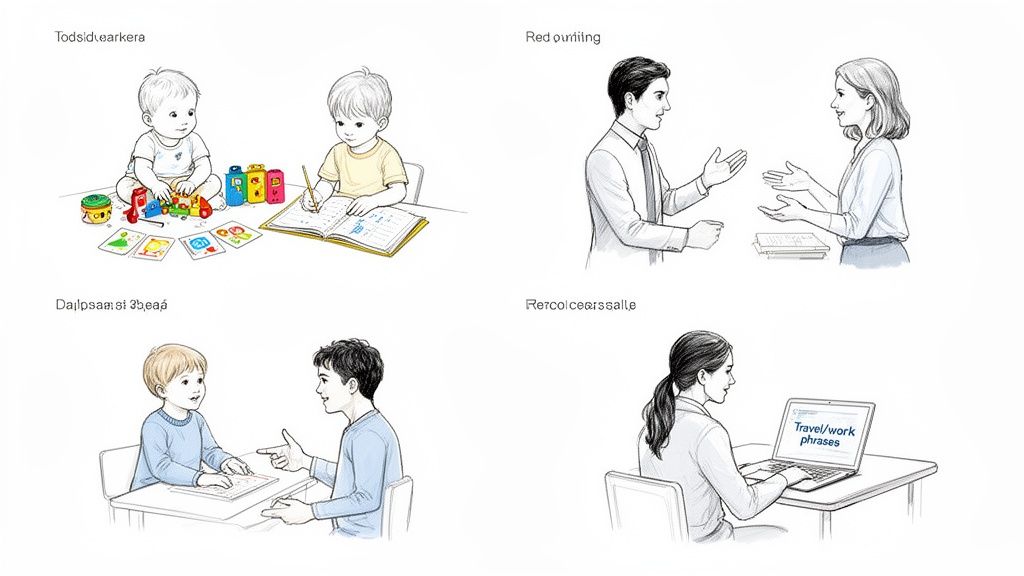
Clarify your learning milestones according to CEFR
Most reputable language schools, including our Hong Kong French Teachers Association, use the Common European Language Reference Framework (CEFR) to set their course levels. This framework, developed by the European Commission, divides language proficiency into six levels, from basic to advanced: A1, A2, B1, B2, C1, and C2.
A complete introductory French course typically aims to guide students with no prior knowledge to an A1 to A2 level . This means that upon completion, you will no longer be "French illiterate," but will genuinely possess the ability to handle basic real-life situations. This framework transforms the abstract concept of "fluency" into a concrete, measurable description of ability, allowing you to clearly understand the learning focus at each stage.
What will you be able to do after completing the introductory course?
Instead of just talking about how many grammar rules you've memorized, imagine scenarios where you can actually apply them! Once you reach A1 to A2 level, you will be able to:
Introduce yourself: Confidently state your name, nationality, and occupation, and naturally ask the other person questions.
Ordering food at a restaurant: Understand the simple menu, order food and drinks from the waiter, and even pay the bill.
Asking for directions and transportation: Ask for directions, understand simple instructions such as "turn left" and "go straight", or buy your own ticket.
Easy Shopping: Easily inquire about product prices and complete basic transactions.
Understanding everyday information: Understand the keywords in weather reports and read store opening hours notices.
Simply put, after completing the introductory stage, you will have the basic communication skills needed for traveling in France. You will be able to handle most predictable and direct information exchanges in daily life, laying a solid foundation for more in-depth learning in the future.
How do we assess your learning progress?
A responsible educational institution will not wait until the end of the course to tell you how well you have learned. Continuous progress assessment is the key to ensuring learning effectiveness. At the French Teachers' Association of Hong Kong, we use a multi-level assessment method:
Continuous in-class assessment: Our native French teachers will use interaction, questioning, and role-playing in class to understand your level of mastery in real time and provide targeted guidance. It's like having a personal trainer by your side, adjusting your posture as needed.
Regular quizzes: After completing each unit, there will be a quiz to help you consolidate the vocabulary and grammar you have just learned, and at the same time get you used to applying knowledge under time constraints.
Mock Exams: If your goal is to take the exam, the course will include mock exams to familiarize you with the DELF A1 or A2 exam format, question types, and scoring criteria, so you can prepare in advance.
Through these specific learning milestones and assessment methods, you can clearly see your progress, naturally giving you more motivation to continue learning. If you have clear exam goals, learning more about our French exam preparation courses will provide you with a more concrete path to higher education.
Who is suitable to enroll in an introductory French course?
Learners from different backgrounds can benefit from introductory French courses; the key is to find a course that suits their needs.
Parents: We hope to provide early language learning for our children aged 3-9, cultivate their interest in French and their sense of language, and lay a good foundation for their future education or enrollment in international schools.
Primary and secondary school students and candidates: Those planning to take public examinations such as IGCSE, IB, and HKDSE need to systematically learn French and undergo intensive training to meet the exam requirements.
Adult learners: Those who learn French for work, immigration, travel, or personal interest, seeking efficient and practical courses, and hoping to master basic communication skills in a short period of time.
Corporate clients: Provide language training for employees to enhance the team's cross-cultural communication skills in order to meet the needs of international business.
No matter which type of learner you are, a good introductory course can tailor the most suitable learning plan for you. Feel free to contact us anytime for a free French proficiency assessment and let us provide you with the most professional advice.
Key factors in choosing an introductory French course: teachers and teaching methods
When choosing a French course, besides the course content, the quality of the teacher and the teaching methods are the real keys to whether you learn well and can persevere. A good teacher and the right methods can make learning easy and effective; conversely, even the best teaching materials may cause you to give up halfway.
At the French Teachers Association in Hong Kong, we have a firm belief: French teaching must be led by native French teachers . This is not only to learn the most standard and authentic accent, but more importantly, to allow you to be completely immersed in an real French cultural environment.
Do you have to learn French from French people?
Imagine you're not learning rigid grammar rules from a book, but a living, breathing language. What your native language teacher can give you is invaluable experience that textbooks can never provide:
Impeccable pronunciation demonstration: French has very subtle nasal sounds, liaisons, and intonation variations, making it difficult to grasp the essence by simply listening to recordings and imitating. A native speaker can immediately identify your pronunciation blind spots and help you build a solid foundation from day one, preventing the development of an odd accent.
Truly "local" usage: Language evolves. Your native language teacher will teach you everyday vocabulary and slang that French people actually use today, and even how to speak appropriately in different situations. You will learn vibrant French, not outdated "bookish French".
Step into the heart of French culture: Learning French is, in fact, exploring French culture. Your native language teacher will naturally share French lifestyle habits, values, and ways of thinking in class, giving you a deeper understanding of the language.
Simply put, learning from a native language teacher is like having a French friend by your side; you learn French that is more vibrant and closer to real life.
How does small class teaching help you learn faster?
Besides the teacher, the teaching method is equally important. We insist on using small class sizes of 2-6 students per class , in order to create a highly efficient learning environment where everyone can fully interact and concentrate.
In large classes, students often become "listeners" due to shyness or lack of opportunity to speak. However, in our small classes, the situation is completely different:
We ensure that every student has ample opportunity to speak. Teachers have the time and energy to monitor each student's progress, providing personalized guidance and feedback. This interactive model greatly enhances your sense of participation and confidence, making speaking French a habit rather than a pressure.
Comparison of different teaching models
Of course, besides small-class teaching, there are other options on the market. Understanding their respective characteristics can help you find the learning path that best suits you. The table below clearly compares the advantages and disadvantages of three mainstream teaching models:
Teaching Model | advantage | shortcoming | Suitable partners |
|---|---|---|---|
Small class teaching | - Strong learning atmosphere with opportunities for interaction and exchange with classmates - Balances personalized guidance with cost-effectiveness - Learn from classmates' questions | - Class times and schedules are relatively fixed. | Students who enjoy group learning, prefer a fixed learning rhythm, and seek high cost-effectiveness. |
One-on-one private tutoring | - Course content and schedule are completely customized - Learning progress can be adjusted according to individual needs - Focused reinforcement of individual weaknesses | - Relatively high cost - Lack of opportunities to practice with other students | Students with specific goals (such as exam preparation or business applications) or who require a highly flexible schedule. |
Online blended learning | - Flexible class location and time - Class recordings can be reviewed to reinforce learning - Access to high-quality teachers from different regions | - It tests students' self-discipline - Interactive experiences may not be as direct as traditional classrooms | Busy adults, those living in remote areas, or students accustomed to digital learning methods. |
In summary, choosing a teaching method and teacher is like finding a reliable guide and a suitable mode of transportation for your learning journey. At the Hong Kong French Teachers Association's campus in Tsim Sha Tsui, we ensure a smooth start and steady progress in your French language learning journey, thanks to our top-notch native French-speaking teachers and efficient small-class teaching model.
Course fees, schedule, and registration process are the same.
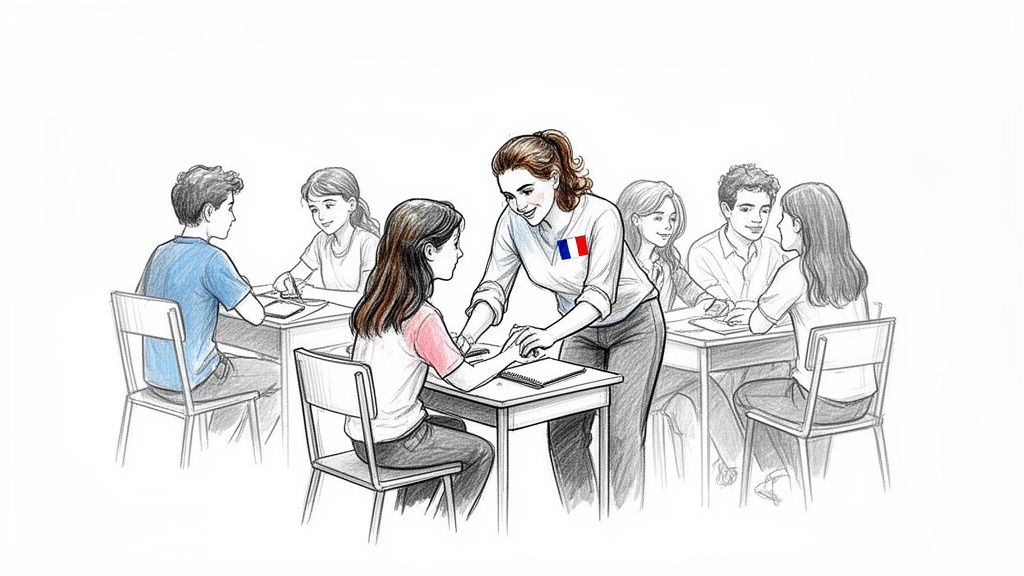
I decided to learn French, so the next step was to find out the fees, time and how to sign up. At the French Teachers Association of Hong Kong, our fee system is clear and transparent. The fee mainly depends on your one-to-one group appointment, the number of lessons in total, and the qualifications of the tutor. The time is also very flexible, with classes available on weekday evenings and weekends. The registration process is very simple and can be completed in three steps.
How are French course fees calculated?
In Hong Kong, the range of fees for learning French can be very wide, but there are several key factors that will directly affect the price. Understanding these points can help you evaluate the cost-effectiveness of different courses.
Course Mode (Group vs. Private): * Small Classes (2-6 people per class): This is the most cost-effective option. You can not only study interactively with your classmates, but also get enough personal attention from teachers, and the tuition is relatively affordable. * One-to-one private tutoring: The cost will be higher, but in exchange for maximum flexibility and personalized teaching. The course content, pace and time are completely customized for you, and are especially suitable for students who have specific goals (such as preparing for the DELF exam ) or who require intensive training.
Class hours and frequency: The total number of hours and the number of classes per week are key to pricing. Generally speaking, if you sign up for a semester or a longer course package at one time, the unit price will usually be equal.
Teacher background: All our courses are taught by experienced native French teachers , and the teaching quality is guaranteed. If they are experienced tutors or have experience in teaching specific exams (such as IB, IGCSE), their private lessons may be slightly higher.
Want to get the most accurate quote? Feel free to WhatsApp us and our course consultants will provide detailed cost information based on your situation.
What are the options for class time?
We understand how busy Hong Kong people live, so we have designed diversified class time so that you don’t have to sacrifice work or rest for studying. Our school is located in a transportation hub, such as Causeway Bay. No matter you live in an area on the edge of Hong Kong, Kowloon and the New Territories, it is very convenient to go to class.
Student Types | Main class time | Remarks |
|---|---|---|
Adult learners | Weekday evenings 7:00 PM - 9:00 PM | Designed specifically for office workers, it allows for easy after-work study. |
Teenagers/Students | Weekends (Saturday/Sunday) mornings and afternoons | In conjunction with school holidays and extracurricular activities. |
Infants/Children | Weekend mornings / Weekday afternoons | Choose the time when children are most energetic and engage in fun learning. |
Flexible demanders | Private lessons, time negotiation | You can directly contact the instructor to find a class time that suits you best. |
Register easily in three steps.
The process of signing up for our introductory French courses is very straightforward and simple. We want you to have a smooth and worry-free experience from the moment you sign up.
Step One: Consultation and Free Assessment First, you can contact us via phone, WhatsApp or website. Course advisors will answer all your questions. If you don’t have any basic knowledge, we will help you arrange a free French proficiency assessment to ensure that you enter the class that best suits your level.
Step 2: Choose the same period of courses Based on your assessment results, learning goals and personal timetable, the consultant will recommend the most suitable course for you, whether it is an adult French class, a youth course or a test preparation class.
Step 3: Confirm registration and payment After choosing your favorite course, you only need to complete the simple registration procedures and pay the tuition (we accept a variety of payment methods), and then you are officially settled and ready for your first French class!
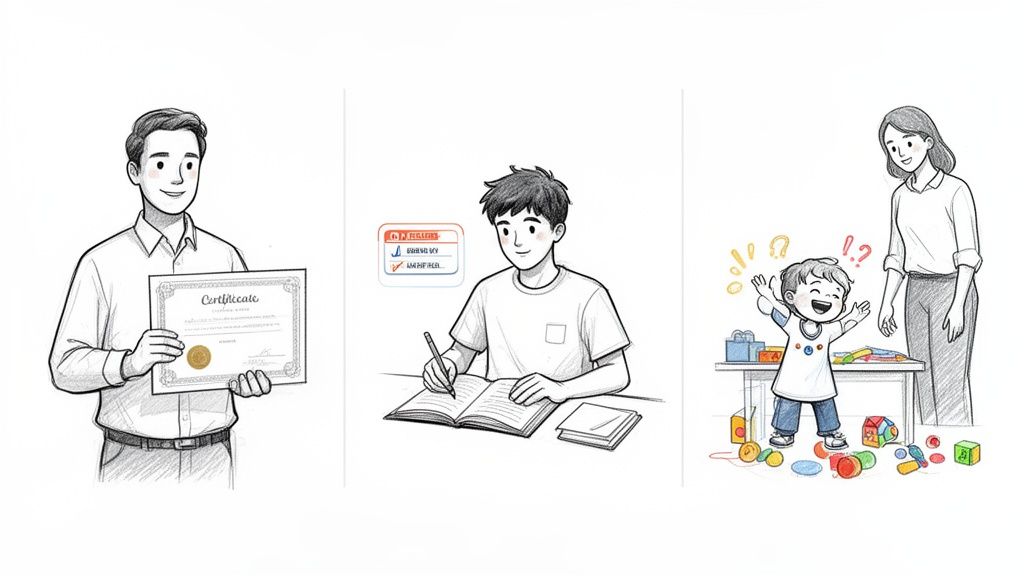
FAQ: Frequently Asked Questions about Introductory French Courses
After reading this, I believe you have a deeper understanding of the introductory French course. However, there may still be some doubts in my heart. Don’t worry, we have compiled some of the most frequently asked questions by Hong Kong students and answered them clearly in one go to help you eliminate the last trace of hesitation.
1. I have zero basic knowledge, will I be unable to keep up?
Absolutely not! Our French introductory course is tailor-made for students with no basic knowledge. The course will start with the most basic French pinyin, letters and simple greetings. In addition, we insist on small class teaching (2-6 people per class) , and native French teachers can take care of each student's progress, ensuring that you study in a stress-free environment.
2. How long does it take to learn how to communicate briefly in France?
Generally speaking, completing about 60 to 80 hours of formal introductory courses (i.e., reaching level A1 of the Common European Framework of Reference for Languages, CEFR) is sufficient for basic communication while traveling in France, such as ordering food, asking for directions, and shopping.
3. At what age is it best for children to start learning French?
Linguists generally agree that the ages of 3 to 6 are the golden period for learning a second language. Children in this age group have a strong ability to imitate sounds and can naturally absorb new languages. Our early childhood French curriculum uses games, nursery rhymes, and stories to help them develop a feel for the language while having fun, laying a solid foundation for future learning.
4. My goal is to take the DELF exam. Which course should I choose?
If you have a clear goal, we strongly recommend enrolling in a DELF exam preparation course specifically designed for the exam. Even at the introductory level, the course content and exercises are closely aligned with the DELF A1 exam format and question types, allowing you to specifically train your listening, speaking, reading, and writing skills from the very beginning, achieving your goals more efficiently.
5. I have already started working, is it too late for me to learn?
Learning knows no order of precedence; those who achieve mastery come first. Adults possess stronger comprehension, logical analysis skills, and clearer motivation when learning languages. Our adult French classes leverage these strengths, emphasizing understanding and practical application rather than rote memorization. Many working professionals have achieved unexpected progress here. For example, at our Central campus, we have many students who come after work to further their studies.
6. How much does your French class cost?
Course fees vary depending on class size (small group/private), total class hours, and instructors. Small group classes offer the best value for money. For the most accurate pricing details, we recommend contacting us directly. Our course consultant will provide a detailed quote based on your needs.
Ready to begin your French learning journey? At the French Teachers Association of Hong Kong , we have the most professional team of native French language teachers and the most suitable courses for you.
Comments