
Online French Learning Guide: Essential Courses, Techniques, and Exam Strategies for Hong Kong Learners
The most effective way to learn French online in Hong Kong is to choose a suitable course mode based on your personal goals (such as exams, interests, or work), such as exam preparation classes for the DELF or IB exams, or flexible one-on-one adult classes. The key to success is to learn from an experienced native French teacher and develop a personalized learning plan that balances practice in listening, speaking, reading, and writing.
Key Takeaways: * Goal-Oriented : Choose the most suitable course based on DSE, IB, DELF exams or personal interests. * Teachers are Key : We insist on using native French speakers to ensure authentic pronunciation and usage. * High Flexibility : Online courses break through time and location limitations, especially suitable for busy Hong Kong residents. * Small Class Sizes : 2-6 students per class ensures ample interaction and speaking practice opportunities. * Leveraging Technology : Utilize online resources and apps to supplement after-class practice and consolidate learning outcomes.
Why is learning French online becoming the new norm in Hong Kong?
The shift in learning models has been particularly evident in recent years, especially in Hong Kong, a city that values efficiency. "Time is money" is not just a slogan, but a true reflection of the daily lives of parents and working professionals. While traditional in-person French classes have their advantages, they are always constrained by fixed times and locations.
Imagine having to travel all the way to a teaching center in Tsim Sha Tsui or Causeway Bay just to attend a class. This is indeed a big challenge for Hong Kong people who are busy with work, studies, and family.
The rise of online French learning perfectly satisfies everyone's pursuit of flexibility and efficiency, completely breaking geographical limitations and allowing learning to no longer be confined to the classroom with its four walls.
Breaking the limitations of time and place
For working professionals, online courses mean they can make good use of spare time. Whether it's during lunch break, after get off work, or even while traveling, they can go online to study anytime without sacrificing precious rest or family time.
Parents also breathed a sigh of relief, no longer having to rush their children to and from tutoring centers. Children can now interact with teachers in a familiar environment, which actually improves their learning. This convenience is an absolute advantage that traditional classrooms cannot match.
Who is it suitable for? Tailor-made solutions for different learners.
Another appeal of online learning is its high degree of personalization. Learners of different ages and backgrounds can find the path that best suits them.
Parents and toddlers (3-5 years old) : You can choose online early learning classes that are highly interactive and fun. These courses usually combine French nursery rhymes, short stories and games, allowing children to absorb language naturally while playing and cultivate early language sense.
For teenage students (aged 10-16) : If your goal is to take public exams such as IB French , IGCSE, or HKDSE, dedicated online preparation courses are the most suitable option. Small class sizes allow instructors to focus more on providing test-taking skills, such as oral expression and essay writing.
Adult learners : Whether for work needs, immigration preparation, or purely personal interest, flexible private one-on-one lessons are available. The course content and pace can be completely adjusted according to your goals, making learning naturally more efficient.
Frankly speaking, the widespread adoption of digital education is reshaping Hong Kong's language learning ecosystem. The online model is not only convenient, but also leverages technology to provide a high-quality and personalized learning experience, making it easier for learners to achieve their goals. Want to know your French level? Feel free to book our free French level assessment .
The trend revealed by the data
This shift is not without reason. According to open data from the Hong Kong Education Bureau, since the rise of digital education, there has been a significant increase in the number of registered students for online language courses in local kindergartens and primary schools. Among children aged 3 to 8, learning French online has become one of the mainstream choices. ( You can view the relevant data and plans from the Education Bureau here .)
The Hong Kong French Teachers Association has also observed this trend. Our online French language courses for young children , taught in small classes of 2-6 students led by native French speakers and incorporating numerous interactive elements, have always been very popular with parents. This proves that, with proper course design, online learning can absolutely rival, and even surpass, the effectiveness of in-person classes.
For learners, choosing the right online French course in Hong Kong is the key to taking the first step toward success.
Want to understand the differences between the two more clearly? We've compiled a detailed comparison table to help you see them at a glance.
Online French courses vs. traditional in-person courses
This table compares the differences between the two learning models in several key dimensions in detail, hoping to help you make the wisest choice based on your individual needs.
Comparison Dimensions | Online French courses | Traditional physical courses |
|---|---|---|
Flexibility | Extremely high, classes can be scheduled anytime, anywhere. | Fixed time and place, lacking flexibility |
Transportation costs | No transportation required, saving time and money. | It takes time and money to travel to and from the school. |
Teacher selection | Access to top native language teachers worldwide | The choices are limited by geographical location. |
Personalization | It is easier to implement one-on-one or small group teaching | With a focus on large-class teaching, it's difficult to keep track of individual progress. |
Learning environment | Studying in the comfortable and familiar environment of home | The classroom environment may create social pressure. |
Technology Applications | Interactive whiteboards, video replays, and other tools can be used. | Relying more on traditional teaching materials and methods |
Social Interaction | Interacting with teachers and students via video | You can communicate face-to-face with your classmates. |
In summary, online courses offer significant advantages in terms of flexibility, cost-effectiveness, and personalization, making them particularly suitable for Hong Kong learners with fast-paced lifestyles. Of course, the face-to-face interaction of traditional courses is also a unique feature, and the final choice depends on your personal learning style and goals.
How to choose an online French course that’s really right for you?
There are a variety of online French courses on the market. To successfully learn French, choosing the right course is definitely half the battle. If you want to avoid the "middling" position, the key is to start from your own actual needs instead of blindly following advertisements.
Before you start, you might as well ask yourself a few core questions: What is my goal in learning French? Do I prefer side learning mode? Zhongyou, what expectations do I have for the teacher?
After thinking about these issues clearly, you can first find a course that can really help you among the many choices. Especially for Hong Kong students and parents who have clear goals, choosing the right course means that time and money are spent wisely.
First, identify your learning goals
Your motivation for learning French directly determines how the course content should be designed. Different goals naturally require different teaching focuses and strategies.
Coping with public examinations : If your goal is IGCSE French , IB or HKDSE , what you need is a systematic and targeted examination preparation course. This type of course is best taught by instructors who are familiar with the relevant examination systems, and will provide a large number of mock test questions and essay marking exercises.
Professional or immigration needs : In order to get a job promotion or prepare for immigration, you may want to specialize in business French, or cope with the DELF / TCF exam. This type of course will focus more on practical conversation, business letter writing, and skills for preparing for specific exams.
Personal interests or travel : If you just want to travel to France so you can communicate easily, or simply out of love for French culture, a course that focuses on daily conversation and has a relaxed pace will be more suitable for you.
Knowing your ultimate goal is the most critical step. Just like using GPS navigation, the destination is clear and you can first plan the fastest and most effective route. If you blindly sign up for a comprehensive course, you may learn a lot of things, but none of them are what you need most.
Secondly, consider the following learning methods that are best for you
There are two main types of online courses: small class teaching and private one-on-one. Both models have their own advantages and disadvantages. Which one you choose depends on your study habits and budget.
The advantage of small class teaching of 2-6 people is that there is interaction and students can study together. At the French Teachers Association of Hong Kong, we insist on small class teaching to ensure that every student has enough opportunities to speak. Healthy competition and mutual encouragement among classmates can often stimulate stronger learning motivation. For learners who have a limited budget and want an interactive atmosphere, this is definitely a cost-effective option.
Private one-on-one tutoring provides the greatest flexibility and personalization. Tutors can design lessons based entirely on your progress and weaknesses. If you have irregular rework hours, or have very specific learning goals (such as preparing for an important French interview), private tutoring is undoubtedly the most efficient solution. You can arrange private French lessons for adults with us at any time.
The flow chart below can help you quickly determine which online French course is best for you based on different learning modes, timetables and goals.
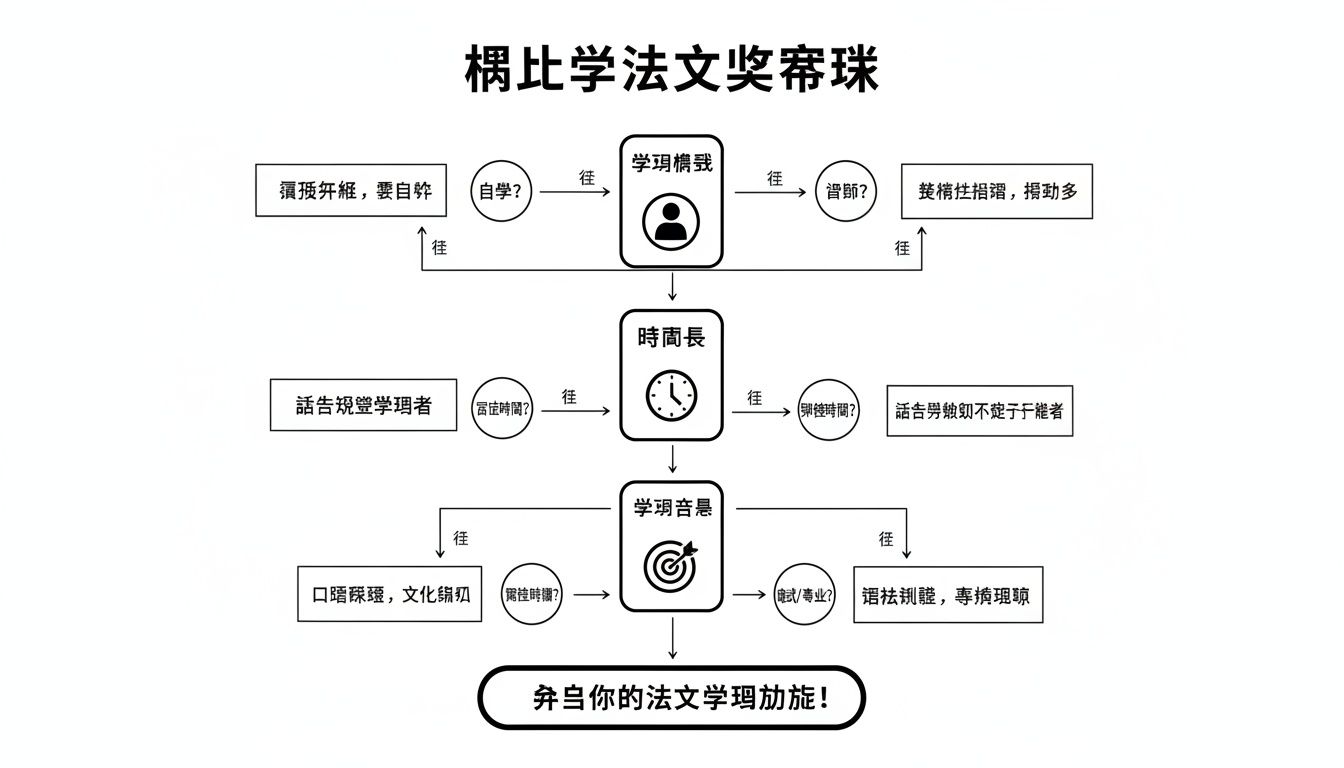
The clear diagram lets us know that a wise decision usually starts with a deep understanding of your own needs, so that you can first find the learning path that best suits you.
Finally, know how to identify truly quality teachers
The quality of the teacher can be said to be the final and most important factor that determines the success or failure of learning. When choosing an online course, be sure to confirm that the instructor is a native French speaker.
Why is understanding so important? Not only to learn authentic pronunciation and intonation, but more importantly, native language teachers can give you the most authentic cultural background and language usage habits, which cannot be learned from books.
You can use the following checklist to evaluate the quality of teachers at a French school:
Tutor background : Are all the teachers French or native French speakers? Do they have relevant teaching qualifications?
Teaching experience : Does the teacher have any experience teaching Hong Kong students? Are you familiar with DELF and IGCSE exams?
Trial class experience : Does the school provide free trial class or level assessment? This is the best opportunity to experience the teaching style firsthand.
Course evaluation : Can’t you find real evaluations from other Hong Kong students online for reference?
Choosing a school like the French Teachers Association of Hong Kong that is composed of professional native French teachers can ensure that you learn the most authentic French from the beginning. Our teachers not only have rich teaching experience, but also understand the learning difficulties of Hong Kong students and can provide the most effective guidance.
Create your personalized French learning plan
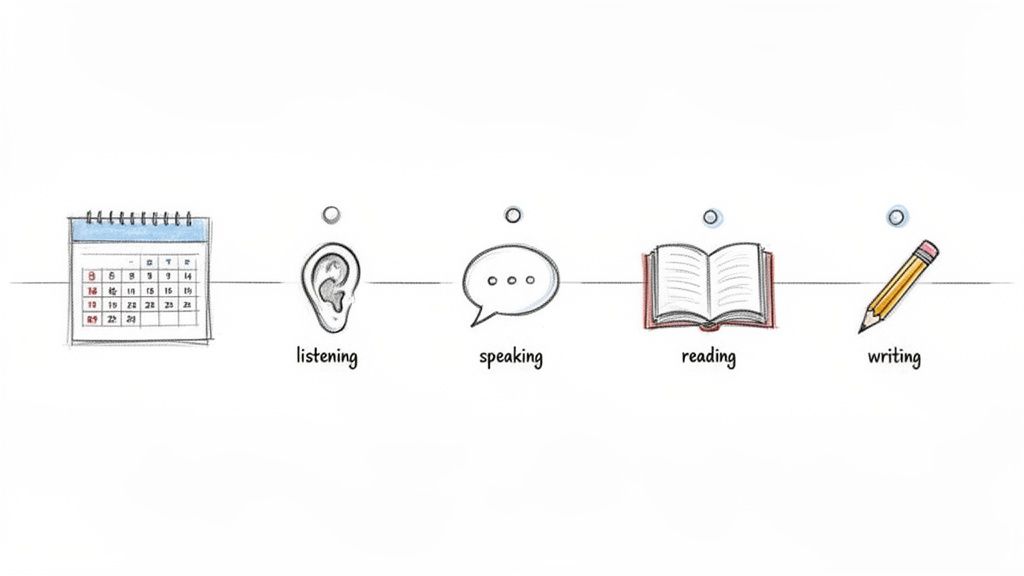
The biggest fear in learning French is losing interest quickly. The key to success isn't fleeting enthusiasm, but a personalized learning plan that allows you to persevere. To transform the idea of learning French online into tangible results, you need more than just a schedule; you need an action plan tailored to your level, goals, and lifestyle.
The essence of this blueprint lies in breaking down grand learning goals into small, easily achievable daily and weekly tasks. This makes progress clearly visible, naturally building the motivation for continuous learning.
Set your goals based on your starting point.
The first and most important step is to honestly assess your current French level. Many people skip this step, but this is often the reason they get lost later.
The Common European Language Reference Framework (CEFR) provides us with a very clear standard, from A1 (beginner) to C1 (advanced), with each level corresponding to very specific language abilities.
Not sure what level you're at? That's perfectly normal. You can try the ** free French proficiency assessment ** offered by the Hong Kong French Teachers Association to accurately understand your strengths and weaknesses. With this benchmark, you can set a realistic and achievable short-term goal.
For example, an A1 level beginner might aim to reach A2 within three months, enabling them to handle simple daily conversations; while a B1 level student might aim to obtain a DELF B2 certificate within six months, paving the way for further education or employment.
Remember, goals must be specific and measurable. Instead of vaguely saying "I want to learn French well," set a goal like "I want to learn to describe what I did last weekend in the past tense (passé composé) within three months." Such a goal will truly guide you every step of the way.
Balanced training in listening, speaking, reading and writing
A healthy learning plan must take into account the balanced development of the four skills of "listening, speaking, reading, and writing". The advantage of online learning is that the resources are extremely rich, allowing you to easily integrate these four skills into your daily life.
Listening training
Beginner (A1-A2) : Spend 15 minutes each day listening to French nursery rhymes or watching the French version of cartoons like Peppa Pig. The key is to get your ears used to the French pronunciation and intonation; you don't need to force yourself to understand every single word.
Intermediate (B1-B2) : You can start listening to podcasts designed specifically for French learners, such as "Coffee Break French" or "Français Authentique". These programs have a moderate speaking speed and the content is very relatable and practical.
Advanced (C1+) : It's time to challenge yourself! Listen directly to local French radio stations such as France Inter or RFI, or watch French news programs to train your comprehension skills in real-world contexts.
Spoken French Practice I know this is the most difficult part for most Hong Kong students. Online small group classes (usually 2-6 people per class) provide an excellent opportunity for practice. You can interact with native French teachers and classmates in a relaxed environment and gradually build confidence in speaking French.
After class, you can use pronunciation websites like Forvo to proofread the pronunciation of each word, or use language exchange apps like HelloTalk to find language partners to practice with and apply what you have learned in class immediately.
Reading training
Beginner : Start with French children's picture books or bilingual articles to gradually build your vocabulary.
Intermediate : Try reading simple news articles from French newspapers such as Le Monde or Le Figaro (which often have a "facile à lire" version) to get acquainted with more authentic usage.
Advanced : It's time to challenge yourself to read original French novels or articles in your professional field. This will allow you to gain a deeper understanding of the complex sentence structures and the culture behind the French language.
Writing Practice Writing is the best way to solidify grammar and vocabulary, bar none. You can start with the simplest thing: writing a sentence in French in your diary every day, and then gradually increase the length. If the online course you're taking offers homework correction, that's an invaluable resource. The teacher's professional feedback can help you quickly identify blind spots and save you a lot of time and effort.
Real Learner Program Examples
Having discussed so much theory, how does it actually work? Let's look at two real-life examples from learners in Hong Kong, which might give you some inspiration.
Case 1: HKDSE Candidates Focused on Objectives
Goal : To achieve excellent results in the French subject of the DSE.
Time : Six months until the exam.
Plan : * Monday and Wednesday : 1.5 hours of private online tutoring , focusing on reading and writing sections of past exam questions, with detailed feedback from the teacher. * Tuesday and Thursday : 1 hour each for grammar review and vocabulary memorization, especially the most frequently used sentence structures in the exam. * Friday : 1 hour of mock oral exams, with repeated responses to different topics from the teacher. * Weekend : Read a French news article and write a 200-word summary, while listening to a 30-minute French podcast to maintain language fluency.
Case 2: Travel enthusiasts who enjoy the journey
Goal : To be able to handle basic conversations such as asking for directions and ordering food when traveling to France in three months.
Time : Studying during my spare time.
Plan : * Two evenings per week : Attend online adult group classes, focusing on learning travel-related vocabulary and situational conversations. * Daily commute : Easily learn 10 new words using apps like Memrise or Duolingo . * Lunchtime : Watch 10 minutes of French travel vlogs on YouTube, relaxing while practicing listening comprehension. * Weekends : Find a language exchange partner and practice the newly learned conversations for 30 minutes , putting your knowledge into practice.
Regular review and adjustment
Remember, a learning plan is not a one-size-fits-all Bible. You should stop every one to two months to reassess your progress. Have you achieved your initial goals? Which areas have you progressed in the fastest? Which parts remain your weaknesses?
You can objectively review your learning progress by taking the regular assessments provided by the school or by taking another free French proficiency assessment . If you find that your spoken French is still a weakness, increase your conversation practice time in the next stage; if you feel that your reading speed has slowed down, find more articles that interest you to read.
Knowing how to adjust flexibly is the only way to ensure your learning plan is always on the most effective track.
How to break through the bottleneck of French pronunciation and conversation?

When it comes to learning French, many Hong Kong students groan. They know the grammatical rules by heart, but when they open their mouths, they become "dumb" or their words always lack that "French flavor". We have seen this situation too many times.
In fact, the two problems of pronunciation and conversation often stem from the lack of a safe and efficient practice environment. Learning French online can fill this gap.
Imagine that you no longer have to face the pressure of a large group of people. You can practice sound by sound and sentence by sentence with a French teacher in your most comfortable home. Gradually accumulated in this way, the confidence in speaking French will naturally come back.
Breaking down the most common French pronunciation difficulties for Hong Kong people
The pronunciation system of French is very different from that of Cantonese. There are a few sounds, which makes it particularly easy for Hong Kong students to pass the test. But don’t be alarmed, as long as you learn the tricks and practice repeatedly with online resources, it is not difficult to defeat them.
Nasal sounds (Les voyelles nasales) : French has several classic nasal sounds, such as an/en, on, and in/ain. Many people accidentally pronounce them as the /n/ sound in English. Remember, correct pronunciation requires airflow from both the oral cavity and the nasal cavity, and the airflow must not reach the roof of the mouth. You can practice in front of the mirror, pay attention to your mouth shape, and then use an online pronunciation dictionary to listen to the native speaker read and imitate.
La liaison : This is the key to making French sound so smooth and musical. To put it simply, a word ending with a consonant is pronounced together with the next word "黐bury" that begins with a vowel. Like "mes amis" (my friends), we would pronounce it /me-za-mi/. In the online class, the teacher will read the sentence aloud and demonstrate in real time whether to legato or not. This kind of real-time feedback is very difficult to learn by reading a book.
Unique R sound (Le "r" français) : The French R sound is a guttural sound, which is pronounced deep in the throat. It is completely different from the English R sound. Beginners can try to hold a small amount of water in the throat, then raise their head and make a gargling sound to feel the vibrating position. Many of our French teachers have their own unique secrets that can help you get that feeling faster.
The secret to breakthrough pronunciation is to break down big goals into smaller pieces. Today I will focus on nasal sounds and practice the R sound while listening to the day. Don’t be impatient. It is best to use the video recording function of online courses to record your own pronunciation in a low tone, and then compare it with the teacher's version. You will soon discover where your blind spots are.
How can small class teaching unleash your conversational potential?
Many people have a misunderstanding that online classes will not have so much interaction. The truth is quite the opposite. Especially if we at the French Teachers Association of Hong Kong insist on truly small class teaching with 2-6 people per class, you will actually get far more opportunities to speak than in a traditional large class room with dozens of people.
In a small and safe learning circle, you will not make mistakes because the teacher can provide you with targeted guidance in real time. Moreover, students are of similar level, making it easier to establish an atmosphere of mutual encouragement and make progress together.
Make full use of online classes to develop proactive dialogue strategies
To take your conversational skills to a new level, it's not enough to just wait for the teacher to ask questions. You have to learn to "take the initiative."
Warm up before class : Five minutes before class, take a look at the topic of the class. In your mind, think of one or two questions you want to ask, or a short story related to the topic. This way, you can express yourself more confidently during the discussion.
Make good use of breakout rooms : If there is a breakout room in class, Qianqi will not be afraid of being ugly! This is a golden opportunity for you and your classmates to practice conversation with minimal stress. Try to dominate the conversation, or share your own opinions.
Take the initiative to ask for feedback : When the class is almost over, you can take the initiative to ask the teacher: "Teacher, I would like to ask if there is anything that could make my pronunciation or sentence structure better today?" This positive attitude will make the teacher more willing to provide you with additional tips.
Want to learn more about how to choose a course that can really help you improve your speaking skills? You can read our other article for a more detailed analysis: How to choose a French conversation class? An article on the secret to understanding fluent speaking .
Practical toolbox for after-school extension
One of the great benefits of online learning is that it can be seamlessly connected to after-class exercises. Here are a few practical tools to help you reinforce what you learned in class in a real-world context:
Language exchange apps : Use apps like Tandem or HelloTalk to find French friends who want to learn Chinese and communicate directly with text or voice messages. This is the best way to put theory into practice, enough to post it.
AI conversation robot : AI tools like ChatGPT can already achieve natural French conversations. You can set up a scene (for example: ordering food in a Paris restaurant) and then role-play with the AI, allowing you to practice without any pressure.
To sum up, the key to breaking through the bottleneck of French conversation is always to "listen more, imitate more, and speak more". Online courses provide you with an ideal starting point, and continuous practice after class is the only way to build your confidence in fluent French.
Online preparation strategies for mainstream French exams in Hong Kong
For many Hong Kong students and their parents, one of the big goals of learning French is to get good results in the public examinations, so as to pave the way for further studies or careers in the future. The good news is that learning French online provides great flexibility for efficient exam preparation. You no longer need to passively follow the progress of the class, but you can use online resources to attack the requirements of specific exams like a sniper.
Whether your goal is DELF , IGCSE , IB French or HKDSE French , the key to success is to thoroughly understand the exam requirements and then tailor a smart online preparation strategy. This process is not just as simple as immersing yourself in practice, but also requires knowing how to use technology and professional guidance to truly convert every effort into scores.
Analyzing online preparation strategies for the DELF exam
The DELF (Diplôme d'Études en Langue Française) exam is very different from the traditional exams that Hong Kong students are exposed to. It does not test your rote memorization, but attaches great importance to your actual communication skills . It tests your comprehensive strength in the four areas of "listening, speaking, reading and writing" in a real French environment.
Online exam preparation can perfectly match the assessment focus of DELF. Just like the production orale part, candidates need to express their opinions on a topic and interact with the examiner. This kind of practice is really difficult to get adequate training opportunities in traditional large class teaching.
At this time, one-on-one online private tutoring plays its greatest role. You can take a high-intensity mock oral test with our native French teachers , who will act as examiners and give you real-time professional advice on your pronunciation, grammar, argument organization and fluency. Through repeated practice, you will build up your confidence and be able to perform with ease when you take the actual exam.
As for the listening (Compréhension de l'oral) and reading (Compréhension des écrits) parts, there are a large number of real corpus online, such as news from French radio station RFI, documentaries on YouTube, etc., all of which are excellent practice materials. Our French exam preparation course will teach you how to use these materials to quickly capture key information and master the techniques to answer different question types.
High-scoring strategies for IGCSE and IB French online exams
For students studying in international schools, the challenges of IGCSE and IB French are more complex. They not only require language proficiency, but also involve literary analysis and cultural understanding.
IGCSE French focuses on the practical application of language, but the writing and oral examination requirements are much more rigorous than ordinary courses. Online courses can provide a large number of targeted writing exercises, such as writing emails, articles, or short stories. You can upload your homework and have the teacher correct it one by one, accurately pointing out grammatical errors and sentence patterns that can be improved. This is definitely the most direct and effective way to improve your writing score.
IB French takes it to the next level, especially for Higher Level (HL) students, who need in-depth analysis and critical thinking of French literary works. It is difficult to master the art of literary appreciation by just exploring on your own.
Studying online gives you access to tutors who specialize in French literature. Through video conferencing, the teacher can lead you to intensively read the designated chapters one by one, and provide an in-depth analysis of the author's writing techniques, themes and contemporary background. This kind of in-depth academic discussion is the key to helping you write a high-scoring paper.
A precise strike in the HKDSE French subject
Although HKDSE's French and liberal arts subjects are relatively niche, the examination pattern is still traceable. Online exam preparation can help candidates focus their firepower and strengthen their weaknesses in a targeted manner. And past papers are the best weapon.
Our youth French course instructors will lead students to analyze Past Papers and summarize question trends and common pitfalls. For example, are reading comprehension type questions the hardest hit area for losing points? What are the most common themes in writing? This digital preparation method is much more efficient than aimless review.
Overview of Online Preparation Strategies for Mainstream French Exams in Hong Kong
In order to help you have a clearer grasp of the preparation directions for different exams, we have compiled the table below to help you grasp the key information at a glance.
Exam Types | Key points of assessment | Online test preparation strategy suggestions |
|---|---|---|
DELF/DALF | Practical communication skills, comprehensive application of four skills | • Intensive simulated oral exams : One-on-one video conversation practice with native language teachers. • Realistic language training : Improve listening and reading comprehension using French news and podcasts. • Structured writing guidance : Learn the standard formats for different writing styles (such as letters and argumentative essays). |
IGCSE French | Practical language skills, grammatical accuracy | • Regular essay feedback : Submit your writing online and receive detailed feedback. • Vocabulary building : Strengthen your vocabulary for common exam topics (such as environmental protection and technology). • Oral exam recording analysis : Record your oral exam practice and analyze and improve it with your teacher. |
IB French | Literary analysis, critical thinking, cultural understanding | • In-depth reading of literary works : Engage in in-depth online discussions with tutors to analyze texts. • Essay structure guidance : Learn to write high-scoring essays that meet IB requirements. • Cultural research projects : Utilize online resources to explore cultural issues in the French-speaking region. |
HKDSE French | Exam techniques and mastery of past exam questions. | • Past Paper Intensive Practice : Systematically complete past exam papers under the guidance of instructors. • Weakness Analysis and Reinforcement : Identify your weaknesses (such as grammar and vocabulary) and conduct targeted remedial work. • Time Management Training : Simulate the real exam environment and practice completing each paper within the time limit. |
To sum up, no matter which exam you are facing, online learning can provide you with flexible and powerful support. The key is to choose a professional institution that truly understands Hong Kong's examination system and is staffed by experienced French-speaking teachers .
Frequently Asked Questions (FAQ)
We have integrated many of the issues that Hong Kong students and parents are most concerned about, hoping to answer your doubts about learning French online and help you take the first step to success.
Q1: I have zero basic knowledge, will it be difficult to learn French online?
Absolutely not. In fact, online courses are particularly suitable for beginners. Many professional organizations, like our French Teachers Association in Hong Kong, have introductory classes specially designed for students with no basic knowledge. The course will be led by native French teachers , starting from the most basic letter sounds (alphabet) and greetings, laying a solid foundation for you step by step. **Small class teaching (2-6 people)** can ensure that teachers take care of each student's progress.
Q2: How to ensure that children can concentrate on online classes?
This is definitely the issue that parents are most concerned about. Professional French courses for children are not about just sitting around and listening to books. The teacher will use many interactive and gamified methods, such as using an online whiteboard to draw together, singing French children's songs, and telling stories to attract the children's attention throughout the process. The kindergarten and children's course instructors of the French Teachers Association of Hong Kong are experienced and are very good at interacting with children in lively and interesting ways.
Q3: If I want to take the DELF exam, how helpful are online courses?
It's very helpful and even very efficient. Professional online exam preparation courses will be designed completely according to the DELF exam pattern. For example, in the oral exam, you can practice directly through video and one-on-one. The teacher will correct your pronunciation and grammar in real time and simulate real exam scenarios with you. For more exam details, you can check out our DELF exam preparation course page.
Q4: How much does the cost of online courses differ from that of in-person classes?
Generally speaking, online courses are much more affordable than physical classes because they save rent and administrative costs. However, price is definitely not the only consideration. What you should pay more attention to is whether the teachers (i.e. native-speaking teachers), class size and course content are suitable for you. Remember, the most cost-effective option is the course that can best help you achieve your learning goals.
Q5: I am not sure when I will return to work. Which online private tutoring is best?
Absolutely. For adult learners who are busy and need to work shifts, online private one-on-one tutoring is the most flexible and efficient option. You can attend class at any time with the teacher at a time that is convenient for both of you, and the course content can be completely customized for you. The French Teachers Association of Hong Kong provides this type of highly flexible French private lessons for adults .
At the French Teachers Association of Hong Kong , our goal is to provide the highest quality and most authentic French education to learners with different needs. Whether you are a parent looking for enlightenment courses for your children, a student preparing for exams, or a working person looking to improve yourself, we have a solution for you.
Contact us now to schedule a free French proficiency assessment and we will plan the most effective learning path for you. https://french.hk
Comments