
A Complete Guide to Intensive French Courses: Helping You Rapidly Improve Your French Proficiency
Want to learn French quickly but feel your progress is slow and you're struggling? Our intensive French course is designed for learners who want to see a breakthrough in their French skills within just a few weeks or months. Through a high-frequency, high-intensity learning model, it helps you quickly achieve your exam, study abroad, or work goals.
Key Summary
Learning mode: high frequency and high intensity, condensing months of courses into a few weeks to create an immersive learning environment.
Suitable for: Candidates preparing for public examinations (DELF, IGCSE, IB), those planning to study abroad or immigrate, professionals who need to work, and students who want to make good use of the long holiday.
Selection criteria: teachers (native French speakers preferred), class size (small classes are the most effective), teaching mode (face-to-face or online), and course content (must comply with CEFR international standards).
Expected Outcomes: After completing approximately 60 hours of intensive training, students with no prior knowledge will generally reach the CEFR A1 level, which is sufficient to handle basic daily conversations and the DELF A1 exam.
In-depth understanding of the core advantages of the French intensive course
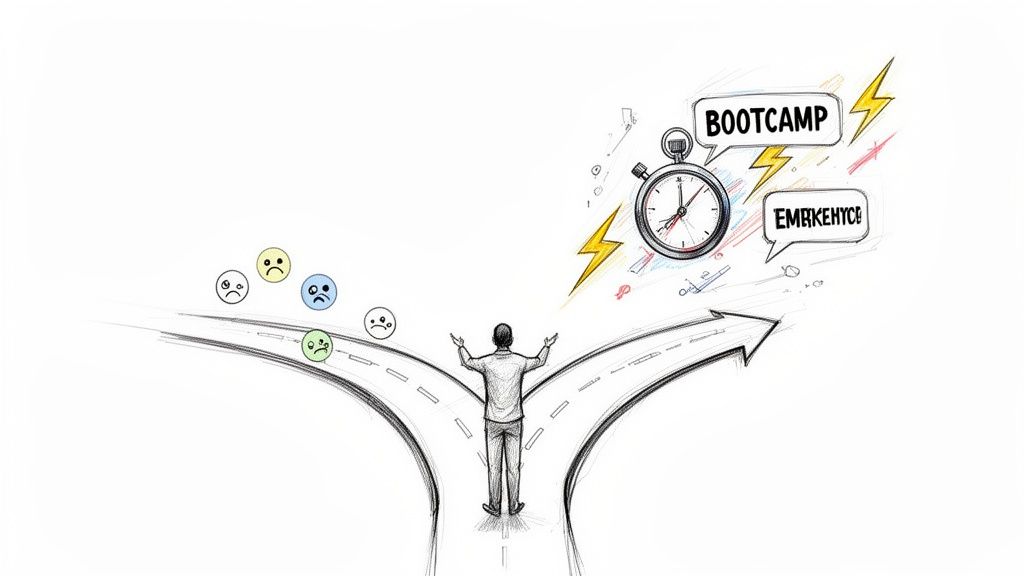
Its core concept is actually very simple: to create a mini version of an immersive French environment for you through high-frequency, high-intensity learning.
Simply put, intensive courses condense several months of course content into a few weeks. This kind of learning rhythm not only allows you to continue to be exposed to French, but also "forces" the brain to quickly adapt and apply new knowledge, effectively avoiding the common problem of "learning today but not remembering it after listening".
The main differences between intensive classes and regular classes
So, what are the differences between intensive courses and regular courses? We can compare them from several aspects:
Learning frequency: Intensive classes usually have 3 to 5 classes per week , or even daily classes; while regular classes usually have 1 to 2 classes per week.
Learning intensity: The content of the intensive course is more compact, requiring you to invest more time in previewing and reviewing, forming a complete learning cycle, and there will be no time for you to "cool down".
Learning outcomes: Due to continuous practice, students in intensive courses usually experience a leap in their spoken fluency and listening comprehension in a short period of time.
Goal-oriented: Intensive courses are designed with very clear objectives, such as preparing for the DELF exam or coping with specific life needs, and each class moves toward that objective.
Imagine learning a language as boiling water. A regular class is like keeping the heat on a low flame intermittently, so the water heats up slowly and may even cool down; while an intensive class is like continuously heating it with a high flame, making the water boil in the shortest amount of time. This high-intensity approach can help you quickly break through learning plateaus.
Our team of native French language teachers utilizes interactive teaching methods in small class settings ( 2-6 students per class) to ensure every student has ample opportunity to speak. Whether your goal is to prepare for the IB French exams or to prepare for immigration, our French courses in Tsim Sha Tsui offer the most direct and effective learning path.
Want to know if this learning model is right for you? Contact us now to schedule a free French proficiency assessment .
Which types of people are best suited for intensive French language classes?
To be honest, intensive French classes are not suitable for everyone. The pace of learning is always very fast. But if you have specific goals or are pressed for time, this high-intensity mode may be your best shortcut, helping you see the most obvious progress in the shortest time.
These types of courses are particularly suitable for the following people:
Candidates: Students preparing for public examinations such as DELF, IGCSE, IB, and HKDSE.
Prospective international students/immigrants: planning to study or live in France or other French-speaking regions.
For employed individuals: Due to work requirements, it is necessary to master business legal communication skills in a short period of time.
Student: I hope to make good use of long holidays such as summer vacation to quickly improve my French skills.
Candidates who gave their all in the open examination
For Hong Kong students who want to take public examinations, there is never enough time. Whether you are taking the DELF, IGCSE, IB French , or HKDSE French , the golden time before the exam cannot be wasted.
The French intensive class is designed to meet this "fighting" need. The course will systematically focus on the four major abilities of the exam - listening, speaking, reading and writing, provide key training, and break down various test-taking skills with you. Through a large number of simulated test questions and practical exercises, you can quickly become familiar with the examination mode, identify your own weaknesses and overcome them one by one, and you will naturally feel more confident when you go to the examination room.
A student who was preparing for IGCSE in our school shared: "In the intensive class two months before the exam, Sir worked with us like crazy on the past paper, and he also caught my verbal weaknesses and practiced one-on-one. The effect was better than when I went to class intermittently for the past six months!"
Friends who are going to study or immigrate to France
Planning to study and live in France or other French-speaking areas means that you must have basic French communication skills before departure, at least to cope with daily life. From renting a house and buying a house, to interacting with classmates and neighbors, to talking a few words and getting along, you will be able to integrate into the local area smoothly.
The intensive class is like an "immersive" crash course, helping prospective international students and immigrants quickly get started and learn some "survival French":
Conversations in daily life situations: such as ordering food at a restaurant, asking for directions, and seeing a doctor. These are all must-learn topics.
Academic Vocabulary Basics: Help you adapt to college classes quickly and understand what Professor Ming is saying.
Cultural etiquette notes: Understand the communication habits of local people to avoid unnecessary misunderstandings.
Through this special training in French courses for adults, students can gain a solid foundation and build up their confidence in speaking French before leaving Hong Kong.
Professionals with urgent needs at work
In Hong Kong, an international city, many workers learn French because of work needs. Maybe the company wants to send you to France, maybe you want to have a meeting with French-speaking customers to discuss business, or maybe you just want to add multiple language skills to your CV to make yourself more competitive.
For this group of professionals, time is money, and learning must be fast, beautiful, and correct. Intensive French classes can focus on business communication skills, such as how to write professional emails, make presentations, social talk with customers, etc. All of them can be learned and used immediately and are very practical.
Students who want to make the most of the long vacation by "overtaking around corners"
Whether you are a primary or secondary school student or a college student, long holidays such as summer vacation and Christmas are definitely a good time to increase your self-esteem. Instead of sitting around the house doing nothing every day, it is better to use this time to concentrate on learning a new language.
The advantage of intensive classes during the holidays is that students are free from the pressure of schoolwork and can devote themselves fully to learning French. This will not only lay a solid foundation for French and liberal arts in the new school year, but also broaden your international horizons and pave the way for further studies or exchange in the future. If you want to know more about the French proficiency level, you can refer to our CEFR level description.
Dismantling the intensive French class: What is the measure of course structure and learning effectiveness?
Many people are curious, can the results of intensive French classes be seen in such a short period of time? The key lies in its "high-intensity and systematic" course design. Intensive classes are definitely not just about piling up class time. Instead, there are plans every day to practice different skills in listening, speaking, reading, and writing, ensuring that you develop balanced development in every aspect and build a good foundation in French quickly.
The core of this model is "immersive learning" and "ready-to-learn". You will be faced with a lot of French information every day, and then practice it immediately in class, slowly turning short-term memory into your long-term knowledge. This is why an intensive class can help you learn in one summer what you usually learn in a few months. If you want to know how to make the best use of your vacation to learn French, you can read our article ** Complete Guide to French Summer School in Hong Kong **.
How do you spend a week in intensive classes?
In order to give you a more concrete experience of the next learning pace, we have created a simulated one-week schedule for the intensive beginner French class (CEFR A1 level):
date | Morning hours (9:30-12:30) | Afternoon hours (2:00 PM - 4:00 PM) | Learning Focus |
|---|---|---|---|
Monday | Phonetics basics, alphabet pronunciation | Basic grammar (subject and verb conjugation) | Lay a solid foundation in pronunciation and learn to build basic sentences. |
Tuesday | Daily greetings and self-introduction | How to say numbers, time, and date | Can handle simple first meeting and communication. |
Wednesday | Scenario dialogue: Ordering food at a restaurant | Listening practice: Simulate real conversations | Train the ability to apply in real life situations. |
Thursday | Reading and writing exercises: understanding simple menu cards and street signs | French Culture Feature: Table Manners | By incorporating cultural background, you can gain a deeper understanding of French. |
Friday | Comprehensive review and group oral practice | Simulated DELF A1 oral exam | Consolidate what you have learned throughout the week and increase your confidence in taking exams. |
As can be seen from this timetable, the course content is linked one by one, starting with the most basic pronunciation, gradually taking you to deal with daily conversations, and building your confidence and ability step by step.
How to evaluate learning effectiveness? Are there any standards?
The results of intensive French classes can be quantified and predicted. All our courses at the Hong Kong Association of French Teachers are designed strictly in accordance with the Common European Framework of Reference for Languages (CEFR) , ensuring that your learning progress has clear international standards to refer to.
Generally speaking, a student with zero basic knowledge can usually reach the CEFR A1 level after completing a four-week full-time intensive class with a total duration of about 60-80 hours . This level means that you can understand and use daily expressions, introduce yourself simply, and have the ability to take the DELF A1 exam.
How far is the learning speed of students in intensive classes compared to ordinary classes? The table below can give you a clear idea.
Comparison of learning progress between intensive and regular French language classes (based on CEFR)
Study time | French intensive course expected level | Expected level of general French class |
|---|---|---|
3 months | A1 - A2 | A1 Beginner |
6 months | B1 | A2 |
1 year | B1 - B2 | A2 - B1 Beginner |
As you can see from the table, intensive classes are significantly more efficient and can help you reach your target level faster.
At the French Teachers Association of Hong Kong, we insist on small class teaching (2-6 students per class) to ensure that each student receives sufficient attention from native French teachers . The teacher can instantly correct your pronunciation and guide everyone to participate in the conversation, which is really important for practicing speaking well. This personalized teaching method is the key to maximizing learning efficiency.
The picture below clearly shows the main reasons why people sign up for intensive French classes.
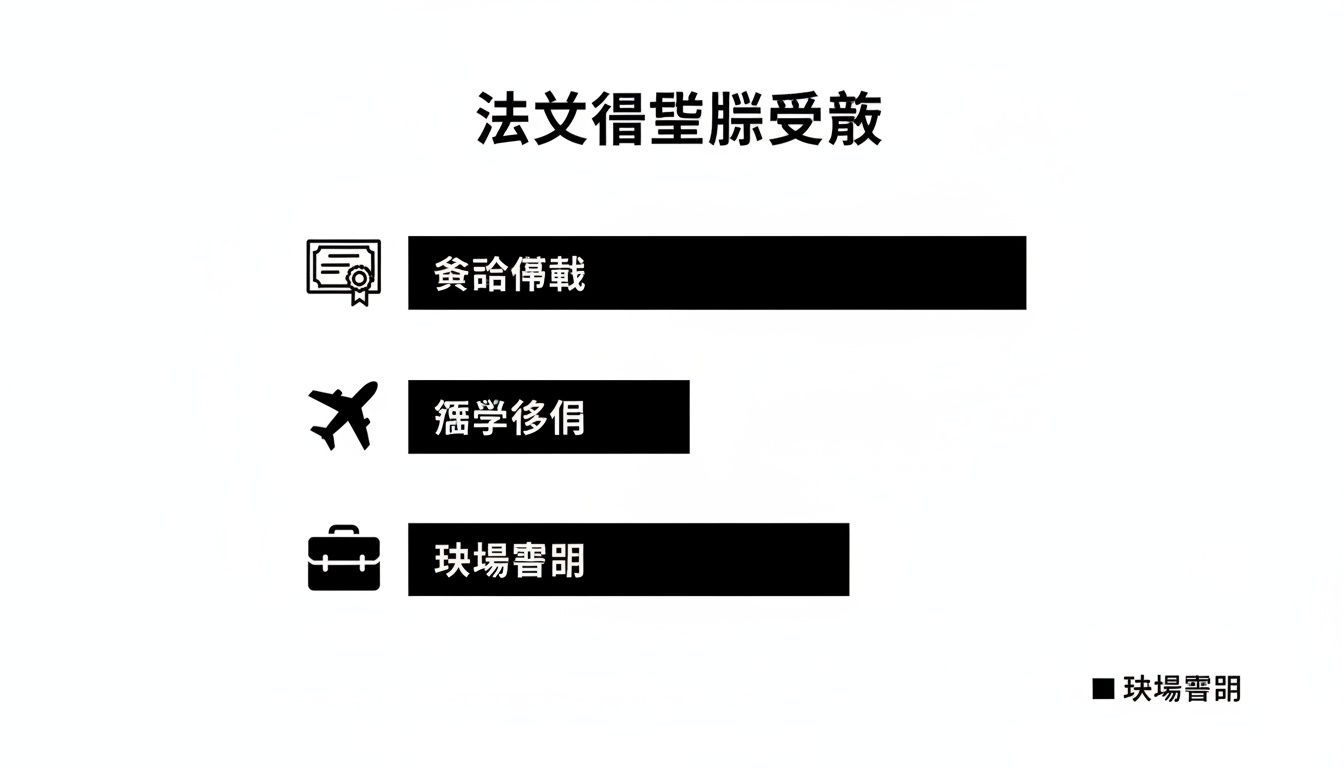
Whether you are studying for exams, studying, or working for immigration, the intensive classes have clear goals and high efficiency, making them the first choice for many Hong Kong people to learn French.
When choosing an intensive French course, is it a smart choice to do some planning first?
Want to choose an intensive French class that suits you best? If you can, if you pick it right, you are already halfway successful. With all the courses on the market, how can you make the wisest decision? The key is to clearly evaluate the four core factors: teachers, class size, class attendance mode, and course content . This way you can first ensure that your time and money are used where they are most valuable.
Faculty background and academic quality
Teachers are definitely the soul of a course, especially in intensive classes with such high intensity. A good teacher can really make your learning more efficient.
When choosing, be sure to put French native speakers (Native Speaker) first . Native-speaking teachers can not only teach you the most authentic pronunciation, but more importantly, they can share the cultural details behind the language, which is something that non-native-speaking teachers can hardly match. Just like the French Teachers Association of Hong Kong, all our tutors are native French speakers, and all of them have professional teaching certification, so the quality is absolutely guaranteed.
A good teacher not only imparts knowledge, he is also a navigator on your learning journey. They can see through your learning blind spots at a glance, and then use the most effective method to guide you to break through the bottlenecks. This is really important in an intensive class where every second counts.
Class size and interaction opportunities
The most important thing in intensive classes is oral practice, so the number of students in the class directly affects your chance to speak and your learning effect. If the class is taught in a large class and it is difficult for the teacher to take care of every student, you may not have the opportunity to speak a word of French in the entire class.
Therefore, small class teaching (2-6 people per class) is definitely the best choice . In this environment, the interaction between teachers and students will be very frequent, and each student can get enough attention and real-time feedback. The teacher has more time to correct your pronunciation and grammatical errors, and students can have more meaningful conversation exercises.
Course format: In-person or online?
In Hong Kong, time and transportation are important considerations. You can choose a class mode that best suits you based on your lifestyle and study habits.
Face-to-face courses: The advantage is that they are highly interactive and have a strong learning atmosphere. If you live in a place with convenient transportation, you can completely immerse yourself in the learning environment by choosing a school building like Causeway Bay or Central.
Online courses: The biggest advantage is that they are flexible and convenient and save a lot of transportation time. They are very suitable for office workers with busy lives or students who live far away. If you want to know more, you can refer to our ** Online French Course **.
In recent years, the demand for French learning in Hong Kong has continued to grow, especially intensive French classes for children and teenagers. The French Teachers Association of Hong Kong’s small class intensive courses (2-6 students per class) are specially designed for toddlers (3-5 years old), children (6-9 years old) and teenagers (10-16 years old), with special emphasis on pronunciation and interaction, with the goal of helping students improve to DELF A1-A2 levels in a short period of time. The passing rate of our DELF and HKDSE intensive preparation classes has always been higher than the market average, attracting many parents from international schools to enroll their children, which also reflects parents’ pursuit of high-quality French education. If you want to know more about the development of French in Hong Kong, you can browse the information of the French Consulate General in Hong Kong .
Course content and international certification
Finally, remember to make sure that the course content is systemic and acceptable. For a high-quality intensive course, the course design should be in line with internationally recognized examinations such as DELF and strictly follow the standards of the Common European Framework of Reference for Languages (CEFR).
In this way, you can first ensure that your learning progress has clear measurement standards, and the knowledge you have learned can also be internationally recognized, which will be of practical help for future studies or work. Before signing up, you may wish to ask the school if it can provide officially recognized proof of study hours.
When choosing an intensive French course, what is the price, location, and location?
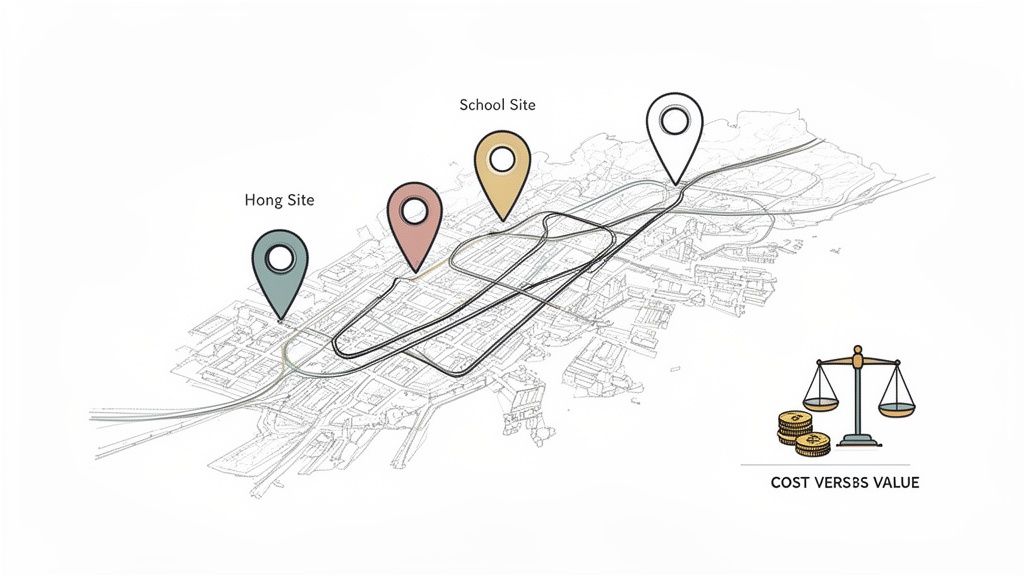
When it comes to enrolling in intensive French classes, budget and location are definitely the two things that many Hong Kong people are most concerned about. To be honest, there is no fixed price for course fees. The difference between affordable and expensive is closely related to factors such as the total number of class hours, class size, and teacher background. Understanding the details behind it can first help you find a truly value-for-money option.
Generally speaking, the fees for high-quality intensive classes taught by native French teachers and offering small class teaching (2-6 people per class) will naturally be higher. Any idea? Because it is highly interactive, teachers can take care of every student and the quality of teaching is guaranteed. Taking a four-week intensive course with a total duration of about 60 hours as an example, the price on the market generally ranges from HK$15,000 to HK$25,000 . You can weigh it according to your own budget.
How important is the main hall in a prime location?
The location of the class is not convenient, which will directly affect your learning motivation and time cost. When you think about how much time it takes to travel back and forth every day, you will understand how important it is to choose a place that is convenient for you. We understand this very well, so we have chosen to open a school building in the most central and most convenient area in Hong Kong, just to make it convenient for you who come from different areas.
Tsim Sha Tsui Campus: The transportation hub in Kowloon. It is very convenient to take the MTR and scheduled buses, serving friends from all parts of Kowloon and the New Territories.
Causeway Bay Campus: The core area of Hong Kong Island, where you can easily go back to work and school. It is the first choice for Hong Kong Island residents and students.
Central Campus: Designed specifically for office workers in the financial district. You can walk directly to class after work and make good use of your time to increase your self-esteem.
Choosing a class location near your work or home can greatly reduce the fatigue of traveling and traveling, allowing you to focus all your attention on learning French. These invisible time costs are definitely worth your serious consideration.
Online courses: the perfect combination of flexibility and cost-effectiveness
In addition to traditional face-to-face classes, online French intensive classes are also an increasingly popular choice. The biggest advantage of online courses is that they break geographical restrictions. No matter where you live, you can attend classes at any time as long as you have an Internet connection, saving a lot of travel time and fares.
For those with limited budget or unstable working hours, online courses provide a more flexible and cost-effective solution. You can sit at home and still enjoy interactive small class teaching led by native French teachers. If you want to know more about the different options for learning French, you may wish to refer to our ** Ultimate Guide to French Tuition in Hong Kong ** for a more detailed analysis and comparison.
Want to know which course program is best for you? Want to know the detailed charges? Contact us now to schedule a free French proficiency assessment !
Frequently Asked Questions (FAQ)
1. I have a "blank slate" in French and have absolutely zero basic knowledge. Will I be unable to keep up?
Absolutely no problem! In fact, many students who enroll in intensive classes start from scratch. Our French intensive class is specially designed for beginners. It will start with the most basic French pinyin and daily greetings. The course content is step-by-step and will guide you step by step. The most important thing is that we insist on small class teaching (only 2-6 people per class), and native French teachers can take care of each student's progress.
2. If you listen well to Chur in the French intensive class, why do you go to class every day? Will it be hard?
The course is indeed relatively compact, but the learning process is definitely not boring. Our teachers are very good at using interactive exercises, role-playing, and group discussions to turn learning into an interesting experience, not just a one-way "listening to a book." We also offer course options of different intensities, so you can choose the most suitable learning pace according to your own time.
3. After taking an intensive class, to what extent will my French improve?
Learning outcomes will always vary from person to person, depending on your personal level of commitment. However, according to experience, a student with zero basic knowledge can generally reach the CEFR A1 level after completing a four-week intensive entry-level class with a total duration of about 60 hours. This level means that you can basically introduce yourself, order food in a restaurant, ask for directions, etc., and you are also capable of taking the DELF A1 exam.
4. Why should I choose a native French teacher? How is it different from local teachers?
In addition to teaching you the most authentic and standard pronunciation, native French teachers can, more importantly, share the cultural details and daily usage behind the language, which you cannot learn from textbooks. In a small class teaching environment, you can quickly improve your speaking confidence through high-frequency interactions with native-speaking teachers.
5. Did you have any class trials or level assessments?
Of course! We welcome you to experience our teaching firsthand. You can contact us at any time to schedule a free French proficiency assessment. At that time, our professional course consultants will talk to you, understand your learning goals, and recommend the most suitable course for you to ensure that the course you choose fully meets your needs.
Want to learn more about the perfect French intensive course for you? Contact the Hong Kong French Teachers Association via WhatsApp now to arrange a free French proficiency assessment! https://french.hk
Comments