
A must-read guide for learning French in Hong Kong: How to master French from zero to fluent

For those looking to learn French in Hong Kong, whether for public exams like the DSE or IB, or to pave the way for career development, choosing the right course is crucial. The most effective method is to follow an experienced native French teacher and choose a small-class teaching model to ensure sufficient interaction and individual guidance. This will help build a solid foundation in pronunciation and grammar, and steadily improve your French proficiency.
Key Summary
Goal-oriented: First clarify whether you are learning French for exams (DELF, IB, HKDSE), work needs, or personal interests, as this will directly affect your course selection.
Teacher quality is key: insist on choosing native French teachers to learn the most authentic pronunciation and language sense.
Small class teaching is more effective: A small class model of 2-6 students allows teachers to take care of each student, provides more opportunities for interaction, and naturally leads to faster learning progress.
Recognized Framework: Choosing a course designed with reference to the CEFR (Common Reference for European Languages) allows for a clear assessment of one's learning progress and ensures alignment with international standards.
Who is this guide for? This guide is suitable for anyone who wants to learn French in Hong Kong, including parents planning for their children's education, students preparing for further education, adults seeking self-improvement, and companies that need to enhance the language skills of their employees.
Why is French the wise choice for Hong Kong people?
French is not only synonymous with fashion and gastronomy, but it is also an international official language spoken by over 300 million people worldwide, playing a vital role in diplomacy, business, and academia. For students and professionals in Hong Kong, mastering French is like obtaining a key to a wider world.
Enhance academic competitiveness
In Hong Kong's education system, French is becoming increasingly important. Many international schools offer French as a compulsory or elective second foreign language. Achieving good results in courses such as IB French or IGCSE is definitely a significant advantage when applying to top overseas universities.
Even locally, French holds a significant position. According to data from the French Consulate in Hong Kong, eight major universities, including the University of Hong Kong, the Chinese University of Hong Kong, and City University of Hong Kong, offer French courses, while Hong Kong Baptist University has even integrated French into its degree programs, reflecting the importance that local higher education places on French.
For secondary school students, starting to learn French as early as possible can not only prepare them well for the HKDSE exam, but also make it easier to integrate with university courses. You can refer to the official report of the Hong Kong Examinations and Assessment Authority to learn more about DSE French statistics.
If you plan to study in France, Switzerland, Belgium, or Canada, obtaining a DELF language certificate is often a basic university admission requirement. Early planning gives you a head start.
Expand your career development path
As an international financial center, Hong Kong is home to a large number of multinational corporations. Especially in industries such as luxury goods, hotels and restaurants, aviation, and fintech, French proficiency is definitely a very valuable skill.
Being fluent in French not only helps you communicate smoothly with clients and colleagues from French-speaking regions, but also makes you a key talent for the company to expand into the European and African markets.
Want to know your French level? Contact us now via WhatsApp to schedule a free French proficiency assessment . Our native French teachers will provide the most professional advice tailored to your needs, helping you plan the most efficient learning path.
French learning blueprints for different age groups
Learning French is never limited by age; the most important thing is to find a path that suits you. Whether you are a parent starting your children's education, a student facing entrance exams, or an adult hoping to improve yourself, as long as you tailor a learning blueprint according to your goals, learning French will naturally be twice as effective with half the effort.
French for toddlers and children (3–9 years): Falling in love with French through play
For children aged 3 to 9, the key to learning French is cultivating interest, rather than rote memorization . Children at this stage have a strong ability to absorb information, and the best approach is to create a relaxed and enjoyable French learning environment through games, songs, stories, and interactive activities.
The focus of learning at this stage is to establish a basic sense of the language and to imitate the most authentic pronunciation of native French teachers . Our goal is not for them to know how many words or how accurate their grammar is, but to make them feel that French is fun from the bottom of their hearts and dare to speak and express themselves.
In this golden period, the focus of learning is "playing", not "learning". A class full of encouragement and fun, such as the children's course set up by the French Teachers Association of Hong Kong in Tsim Sha Tsui, can help children establish a positive and long-term connection with French, laying the solid foundation for future systematic learning.
French for teenagers (ages 10–16): From academic foundation to exam preparation
As students enter adolescence, learning French becomes more focused, often linked to school courses or public examinations. Whether preparing for IGCSE French , IB French , or HKDSE French , learning strategies at this stage need to be more systematic, closely integrating language skills with test-taking techniques.
This stage of the course will place particular emphasis on:
Grammar structure: systematically learn French grammar and understand core concepts such as verb conjugation and tenses.
Expand vocabulary: Strategically increase vocabulary based on the exam syllabus and daily themes.
Listening, speaking, reading, and writing: comprehensively improve all four aspects of ability, especially those requiring targeted training, such as oral exams and writing.
Finding a teacher familiar with the Hong Kong examination system is especially important, as they can provide targeted practice and test-taking strategies to help students achieve academic excellence. If you are still comparing different courses, you can refer to our French class recommendation guide to learn more about our options.
Adult French: Goal-oriented, flexible and efficient
Adults usually have a clear motivation for learning French, such as work requirements, immigration plans, communication during travel, or personal interest. Because time is precious, learning must be efficient.
The first step is to set realistic short-term and long-term goals. For example, "Be able to order food in French at a restaurant within three months," or "Obtain the DELF A2 certificate within a year." With clear goals, you will have the motivation to persevere.
The second step is to choose a flexible learning model. Small group classes ensure you have ample opportunity to practice speaking, while private French lessons for adults can be completely tailored to your progress and needs. For busy professionals, this personalized learning approach is often the most efficient choice.
To help you better understand the learning directions for different age groups, we have compiled the following table:
French learning goals and curriculum suggestions for different age groups
Learning stage | Main objectives | Recommended learning mode | Course Recommendation (Hong Kong French Teachers Association) |
|---|---|---|---|
Toddlers (3-5 years old) | Cultivate interest, develop language sense, and imitate pronunciation | Games, songs, and story interactions | Playgroup |
Children (6-9 years old) | Strengthen pronunciation, learn basic vocabulary and simple conversations. | Group activities, role-playing | Children's interest classes, beginner group courses |
Teenagers (10-16 years old) | Systematically learn grammar and prepare for public examinations (IGCSE/IB/DSE) | Targeted exam preparation classes, one-on-one tutoring | Exam preparation classes for teenagers, private tutoring |
aldult | Achieve personal goals (job, immigration, interests, DELF exam) | Small group classes, private lessons, themed workshops | Adult group classes, one-on-one private lessons |
In conclusion, regardless of your starting age, as long as you find a learning pace and method that suits you, the journey of learning French can be full of fun and rewards.
How to choose the French course that’s right for you?
With a wide variety of French courses available in Hong Kong, choosing a good one can be quite a headache. However, it's not difficult to make the most of your time and money. By focusing on three core aspects—teachers, class size, and teaching style—you can clarify your thoughts and find the option that best suits you.
The flowchart below clearly illustrates the learning paths for different age groups in French, helping you quickly find your place.
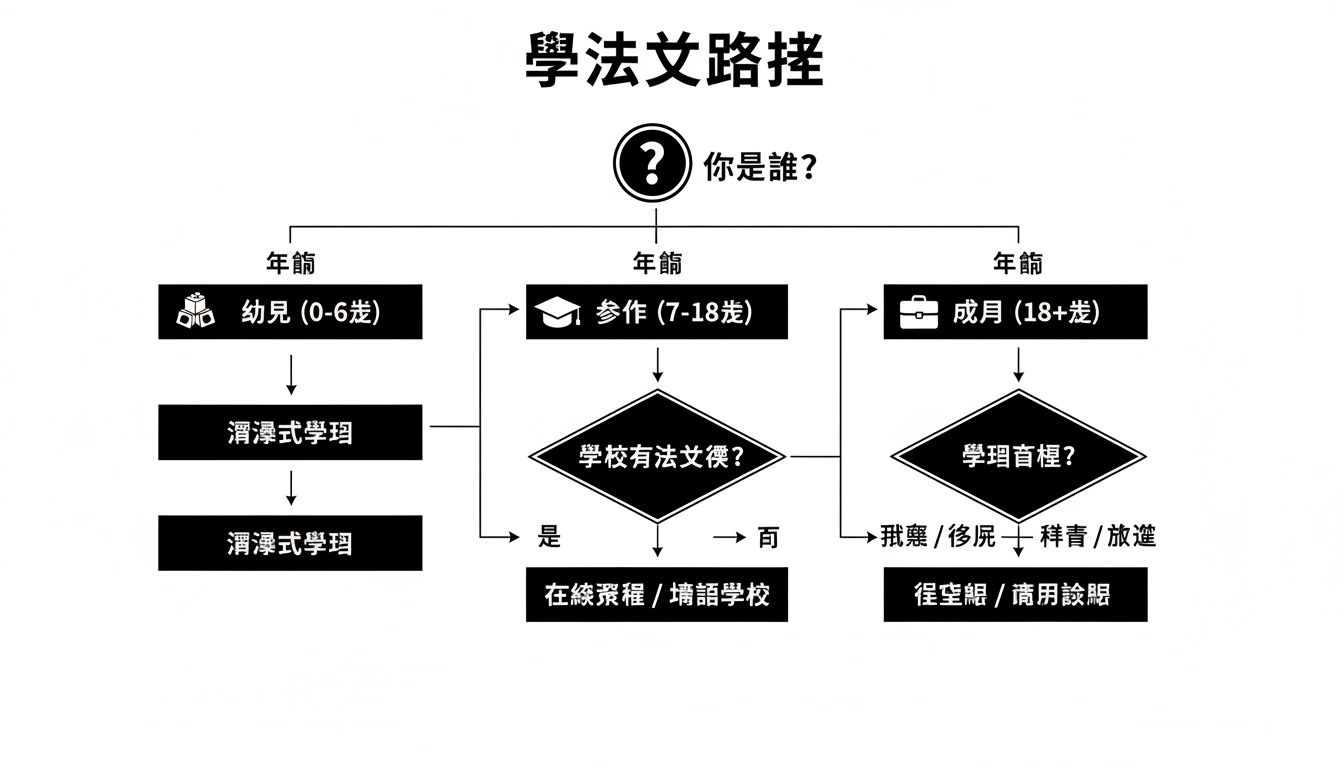
As shown in the diagram, children, teenagers, and adults all have clear learning starting points and goals. When choosing courses, these paths should be used as a foundation.
French native language teacher vs. non-native language teacher
Choosing a teacher is absolutely the most crucial step in learning French. Although local teachers may better understand the learning difficulties of Hong Kong students, native French teachers have an irreplaceable advantage in terms of pronunciation, intonation, and cultural background.
Learning with a native language teacher exposes you to the purest and most authentic accents from the very beginning. This is not only for speaking better, but more importantly, it helps you develop accurate listening skills so that you can easily understand real conversations between French people from different regions in the future.
Learning a language is not just about memorizing words and learning grammar; it's about experiencing a culture. A native language teacher will naturally incorporate the French way of thinking, lifestyle, and even authentic idioms into the teaching, making the French you learn more three-dimensional and "vivid."
Small class teaching vs. large class teaching
Often, the low tuition fees touted by large chain schools seem attractive, but the drawbacks of large class sizes (usually more than 10 people ) are quite obvious: you don't have many opportunities to practice speaking throughout the class, and it is difficult for teachers to keep track of each student's progress.
In contrast, **small class teaching (2–6 students per class)** is quite different, as is the model that the French Teachers Association of Hong Kong has always adhered to, ensuring that every student receives sufficient attention.
More opportunities for interaction: With fewer people, you naturally have more time to communicate with teachers and classmates in French, making practice more than just theoretical.
Personalized guidance: The teacher can correct your pronunciation and grammar mistakes in real time, and even adjust the teaching focus according to your weaknesses.
A better learning atmosphere: In a familiar group environment, students are usually more willing to ask questions and express themselves, and the learning effect is naturally twice as good.
Online vs. In-person courses
After the pandemic, online courses became very common. In fact, both have their advantages and disadvantages, and how to choose depends entirely on your lifestyle and learning habits.
In-person classes If you enjoy face-to-face interaction and need a fixed time and place to motivate yourself, in-person classes are perfect for you. For example, at our Causeway Bay campus, you can receive immediate feedback from teachers and learn alongside classmates, encouraging each other and naturally boosting your motivation.
Online courses offer great flexibility for busy working professionals or students living far away. You can save a lot of commuting time and attend classes from the comfort of your home. For more information, please refer to our detailed introduction to online French courses in Hong Kong .
In conclusion, there is no absolutely best choice, only the choice that best suits you. Before enrolling in any course, you might as well apply for a free trial class or take a French proficiency assessment to experience the teacher's teaching style and classroom atmosphere firsthand, so that you won't make a mistake.
A Complete Guide to Common French Exams in Hong Kong
Want to boost your resume with French exams in Hong Kong? Whether for further education, employment, or personal achievement, understanding the rules and requirements of various exams is the first step towards success. From the internationally recognized DELF to school curricula like IGCSE and IB, and the local HKDSE French subject, each exam has its own set of rules, and the preparation methods naturally differ greatly.
Quickly understand the four major French exams
DELF/DALF: This is arguably the most prestigious international certificate, directly linked to the CEFR (European Standard Language Accelerator). The certificate is valid indefinitely and is highly recognized for both applying to overseas universities and immigration purposes.
IGCSE French: This is a subject that many international school junior high students encounter. The exam content is very practical, emphasizing real-world communication skills and cultural awareness, and is a crucial step in laying a solid foundation for later challenges in IB French.
IB French: The academic requirements are much higher. It not only tests your French proficiency, but also values your ability to analyze literature, think critically, and appreciate culture. It is definitely a challenge that tests your comprehensive abilities.
HKDSE French: This is a university entrance option under the local education system, belonging to Category C elective subjects. The results can be used for university applications through JUPAS, opening another door for students who are good at French.
DELF/DALF: Your Passport to International French
DELF (Diplôme d'Études en Langue Française) and DALF (Diplôme Approfondi de Langue Française) are official diplomas issued by the French Ministry of Education and are recognized worldwide. Their greatest advantage is their clear correspondence between the six levels from A1 to C2, corresponding to the Common European Framework of Reference for Languages (CEFR), allowing you to immediately see your French proficiency level.
Unlike many language exams with limited validity periods, DELF/DALF certificates are valid indefinitely . If you plan to study at a university in France, a B2 level certificate is generally the minimum requirement. For those wishing to immigrate to Canada or France, this certificate is also a significant advantage. The exam comprehensively assesses listening, speaking, reading, and writing skills, emphasizing overall communication ability.
IGCSE French: Laying a solid foundation and looking towards the international arena.
For students studying at international schools, the IGCSE French exam is an important milestone. The goal of this exam is clear: to cultivate your confidence and ability to communicate in French in everyday life.
Just look at the exam content: writing a simple email, chatting about family life, discussing holiday plans… these are all very relatable topics. However, don't think it's easy. To get a high score, you need a solid foundation in grammar and a sufficient vocabulary. Especially in the oral exam, the examiner wants to see you speak naturally and fluently, not just rote memorization.
IB French: A Deep Challenge to Scholarship and Thinking
IB French is on a completely different level. The course is divided into different levels such as Ab Initio (beginner), Language B (standard or advanced), and Language A (literature), and the academic depth is far beyond that of general language exams.
For example, in Language B, you not only need to be fluent in French, but also use French to discuss global issues such as health, environment, and technology, and even analyze literary works or news reports. If you are studying at the Advanced Level (HL), you will need to read two original French works. The oral exam is not a simple question-and-answer session, but rather you will be given a picture or a quote and asked to give a well-organized personal opinion on the spot.
For students preparing for IB or IGCSE, the school curriculum alone may not be sufficient to meet the high standards of the exams. Seeking additional support is a good way to effectively improve grades. For example, attending small group classes specifically designed for test takers, where experienced native French speakers provide targeted training to address your weaknesses, can be very effective.
HKDSE (French): Another Pathway to Local Education
The French subject in the Hong Kong Diploma of Secondary Education Examination (HKDSE) falls under Category C Other Languages, and the exam paper directly adopts the AS level standards of Cambridge University's CAIE. This creates another possibility for local students with a French background in JUPAS.
Although the number of applicants is small, local universities will recognize good results. However, it's important to note that the AS level is quite challenging, requiring a high level of grammatical accuracy and strong argumentative writing skills. For more specific test-taking strategies, please refer to our French exam preparation course for more professional advice.
No matter which exam you're aiming for, early planning, understanding the exam format, and finding the right professional guidance are absolutely key to success. If you're unsure of your level or don't know where to start, feel free to contact us. We can provide a French proficiency assessment and tailor the most suitable preparation plan for you.
Practical tips for learning French from scratch
To learn French well, rote memorization is absolutely not the way to go. Many people start with great enthusiasm, but quickly get stuck due to incorrect methods, wasting time and effort. The key to truly going from zero to fluency is to build a solid foundation from the beginning and to know how to integrate French into daily life.
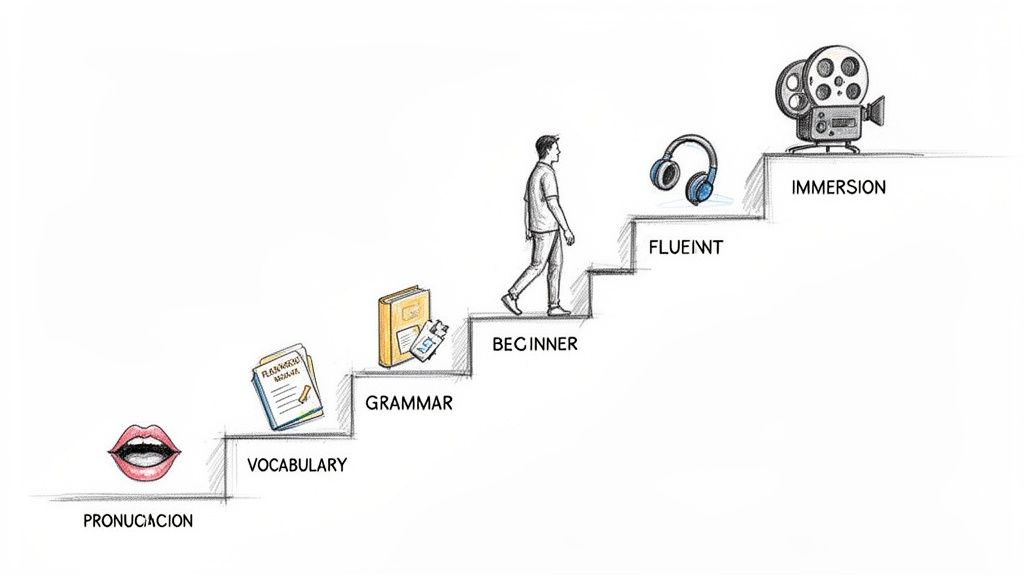
Pronunciation is the first hurdle in learning French.
French pronunciation rules are very different from English, and many beginners are confused by unique phonetic phenomena such as nasalization and liaison. I can say with certainty that if you don't build a solid foundation in pronunciation, it will be very difficult to correct later, and it may even directly affect your listening comprehension.
This is why we always emphasize how important it is to learn from a native French language teacher . They can give you the most accurate pronunciation demonstrations, correct your subtle mouth shapes and tongue positions in real time, and ensure that you are on the right track from day one.
How can you effectively expand your vocabulary?
If you're still rote memorizing vocabulary lists, stop immediately! This method is extremely inefficient. To truly "swallow" vocabulary, you need a smarter strategy:
Thematic memorization: Don't memorize new words one by one in isolation. Try learning them in a group around a theme, such as "going to a restaurant". You can learn the related vocabulary from ordering food and drinks to paying the bill all at once. This way, the memorization will be more three-dimensional.
Make good use of technology: There are many useful apps now, such as Anki or Quizlet, that use the scientific principle of spaced repetition to help you consolidate your memory more effectively.
Learn from context: When reading short articles or news, don't rush to look up unfamiliar words in the dictionary. Try to guess their meaning from the context before confirming. This back-and-forth approach will make a much deeper impression.
Grammar doesn't need to be memorized by rote; you need to learn to "internalize" it.
I know that French grammar, especially verb conjugation, can be daunting for many. But grammar is the skeleton of a language, and you can't avoid it. The key is that you don't need to memorize the rules like you would read legal statutes.
Instead of memorizing the six verb conjugations of "être," it's better to memorize a few practical examples: "Je suis de Hong Kong." (I come from Hong Kong) and "Vous êtes prêt?" (Are you ready?). After encountering numerous such situational examples, these grammatical rules will naturally become internalized as part of your language ability.
In fact, the importance of a professional teaching method is evident in student performance. Data shows that the vast majority of students enrolled in certification courses in Hong Kong not only achieve their expected learning goals but also exceed them. This proves that a systematic curriculum and experienced native language teachers can indeed bring significant results. For more information on the effectiveness of French courses in Hong Kong , please refer to relevant statistics.
Create your own immersive learning environment
In addition to attending classes, you should actively create opportunities for yourself to come into contact with French in your daily life.
Auditory input: During your commute, listen to French podcasts or RFI (Radio France Internationale) news to get your ears used to the French intonation.
Visual input: Change your phone or computer system language to French; when watching Netflix, boldly challenge yourself with French dubbing and subtitles.
Social practice: Find a language exchange partner or participate in more cultural activities held at our Central campus to practice using what you've learned in real conversations.
If you're feeling lost about your progress or unsure of your next step, feel free to schedule a free French proficiency assessment . Our professional native-speaker teachers will personally evaluate you and provide personalized learning suggestions to help you learn French more efficiently.
Frequently Asked Questions (FAQ) for Learning French
We have compiled the most frequently asked questions by Hong Kong students, and senior French teachers from the Hong Kong French Teachers Association will answer them for you, hoping to help you dispel any doubts on your learning journey.
1. How long should we study before we get to basic French?
Generally speaking, if you attend classes every week and review regularly, you can handle basic daily conversations, such as introducing yourself, asking for directions, and ordering food at a restaurant, in about 6 to 9 months , which is roughly equivalent to CEFR A2 level. If you want to have more in-depth conversations, you usually need more than a year of continuous learning.
2. Is it really difficult to learn French?
French does have its challenges, especially conjugation and some pronunciations, which may be unfamiliar to Hong Kong people. But "challenge" does not mean "failure to learn". The key is to work with an experienced native French teacher to build a good pronunciation foundation from the start. You will gradually discover that French grammar is very logical. As long as you master the rules, learning will become easier.
3. Should I choose a private class or a group class?
This depends on your learning goals, time, and budget:
Small group classes: Suitable for learners who enjoy interaction and are more motivated to learn with classmates. In a small class environment of 2-6 people , you will have ample opportunity to practice, and the tuition fee is relatively affordable.
Private tutoring: If you have specific goals (such as preparing for the IB French exam) or irregular working hours, private tutoring offers the greatest flexibility, with content completely tailored to your individual needs.
4. At what age is it best for a child to start learning French?
Any time is a good time, but the earlier you start, the easier it is to naturally develop a sense of language. The golden age for language learning is between 3 and 6 years old , when children can absorb authentic pronunciation like a sponge through games and songs. However, adults can also learn very quickly if they have clear goals and strong motivation.
5. What is special about the courses of the French Teachers Association of Hong Kong?
We insist on hiring only native French speakers with professional teaching qualifications to ensure you learn the most authentic and genuine French. All courses are taught in small classes of 2-6 students , guaranteeing each student receives sufficient attention from the teacher. Whether you are enrolling your child in a French language course, or learning for exams or work, we can provide a teaching solution that best suits your needs.
6. How can you predict yourself and your family?
The most direct approach is to undergo a professional assessment. We offer a free French proficiency assessment , conducted personally by a French teacher. After completion, we will recommend the most suitable course starting point based on your level and goals, ensuring your time and money are used effectively.
7. Does learning French help with the DSE exam?
Absolutely. The French language subject in the HKDSE falls under Category C (Other Languages), and the results can be used for university applications through JUPAS. For local students with a French background, this is another option to broaden their educational pathways and increase their academic advantage.
Want to take the right first step on your French learning journey? Contact the Hong Kong French Teachers Association now to schedule a free trial class or level assessment. Let our professional team in Tsim Sha Tsui plan the most effective learning path for you.
Comments