A Complete Guide to French Courses in Hong Kong: Which Schools Are Best for Learning French in 2026?
- French Teachers Team

- Feb 20
- 20 min read
If you want to choose your favorite French course in Hong Kong, the most important thing is to first figure out your learning goals, budget and class mode. Whether it is for children to prepare for international examinations such as IB and IGCSE, or for adults to further their studies for hobbies or careers, as long as their goals are clear, they can find the most suitable choice from many French schools. For example, the French Teachers Association of Hong Kong provides small classes and private courses led by native French teachers.
The main points of this article
Goal-oriented : Choose the appropriate course type based on your learning objectives (exams, interests, immigration).
Teacher quality is key : prioritize native French-speaking teachers with teaching certifications to ensure accurate pronunciation.
Teaching models : Small class teaching (2-6 people) is suitable for interactive learning; private tutoring provides the most personalized guidance.
Exam support : Confirm whether the school offers preparation courses for exams such as DELF, IB, IGCSE, and HKDSE.
Location and flexibility : Consider the location of the school (such as Tsim Sha Tsui, Causeway Bay) and whether online course options are offered.
How to choose the French course that best suits you
When many Hong Kong people think about learning French, the first question they ask is: "How good is it to learn French?" In fact, there is no standard answer to this question. Any idea? Because the best choice depends entirely on the learner's needs, age, and ultimate goals. Just think about it, a game-oriented course designed for three-year-old children and an intensive reading class specially designed for adults preparing for the DELF B2 exam. The content and teaching methods of the two are definitely completely different.
So, instead of looking for a needle in a haystack, it’s better to stop and ask yourself a few key questions:
A side study? Are you studying on your own, or are you helping your children or teenagers to register for school?
What are you learning to do? In order to cope with school examinations (IGCSE, IB, HKDSE), international certificate examinations (DELF), or simply to cultivate interest, determine the work needs?
Interested in learning something? Do you prefer group classes that are highly interactive and allow you to make progress together with your classmates? Or private one-on-one tutoring that is flexible enough to allow you to follow your own pace?
Once you answer these questions, your choices will be narrowed down a lot, and you can quickly lock in the course you like most. For example, if the goal is to help your children cope with the IB French exam, then you should give priority to native French teachers who have relevant exam coaching experience and use small class teaching .
To make it clearer for you, we have prepared the flow chart below. You can see that according to different types of learners (children, adults, candidates), you should choose your own learning path step by step.
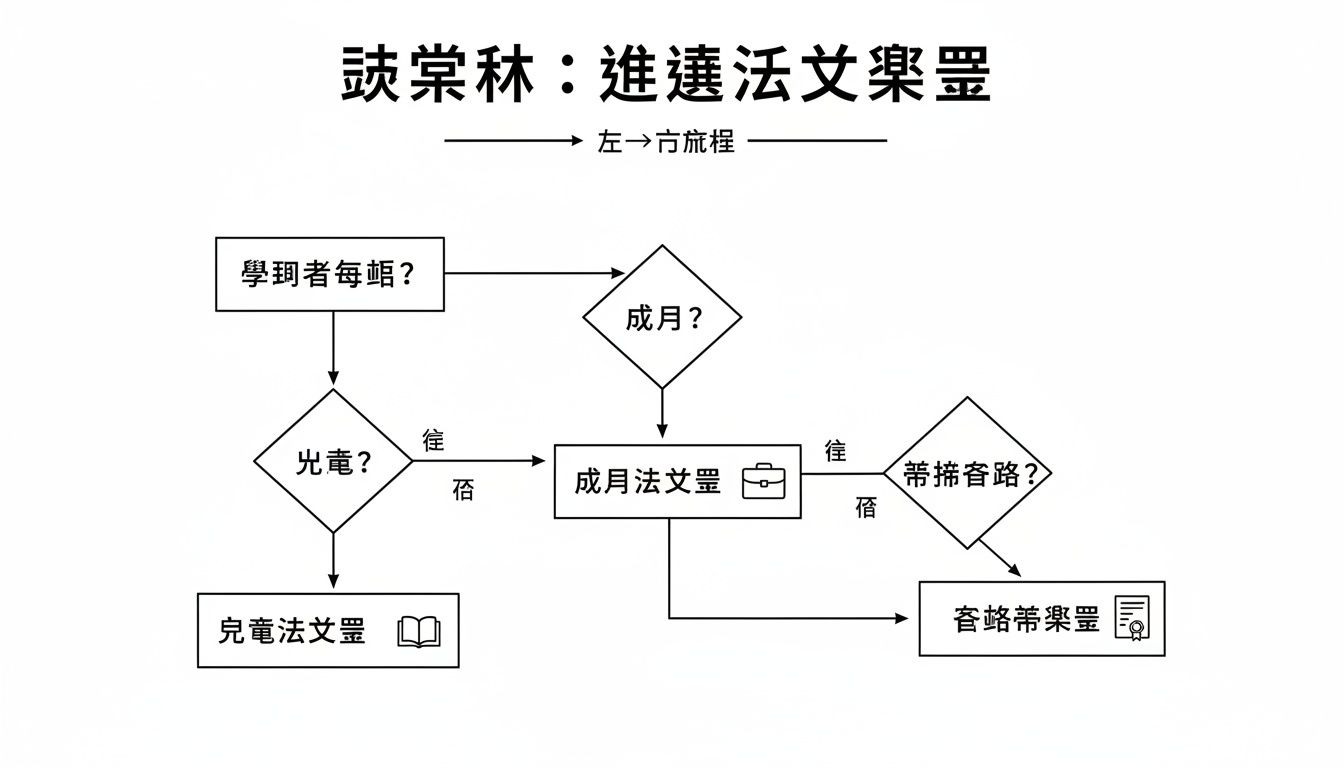
The core concept of this flow chart is "goal-based". Whether your starting point is for your children's education, personal enhancement, or preparing for exams, if you follow this path, you will always find the most efficient learning plan.
To facilitate quick comparison, we have compiled a quick list to directly recommend corresponding course options based on the most common needs of Hong Kong learners.
A quick overview of French course options for different learning goals
Learning objectives | Recommended course types | Ideal teaching model | Teachers are key | Features of the recommended institutions |
|---|---|---|---|---|
Early childhood education | Interactive game class, story class | Small group class (2-4 people) | Patient and skilled in teaching children | The atmosphere is relaxed and the teaching materials are interesting. |
Primary and secondary school examinations (IGCSE, IB, HKDSE) | Exam preparation classes and test-taking skills classes | Small group classes or one-on-one tutoring | Familiar with the exam framework and have past exam results | Highly targeted, provides mock test questions |
Adult Interests/Travel | Beginner's Class, Conversation Class | Small group class (4-6 people) | French native speaker, with perfect pronunciation | Emphasis on practical conversation and cultural introduction |
Professional/Immigration Needs | DELF/DALF exam preparation courses, business French | One-on-one, customized courses | Possesses professional certifications and extensive experience. | Flexible progress and content closely aligned with needs |
After reading this list, I believe you will have a clearer idea of your direction. Choosing a course is like finding a key to open a door. Once you find it, the path to learning will naturally be smooth.
Who is it suitable for?
Parents: Want to plan a long-term language learning path for their children to prepare for international exams such as IGCSE and IB.
Candidates: You are preparing to take public examinations such as DELF, TCF or HKDSE and need targeted intensive training.
Adult learners: Due to interests, work or immigration needs, they want a systematic, time-flexible course.
Corporate customers: The company needs to provide employees with tailor-made French training that meets industry needs.
Wondering which course is best for you or your child? It is better to contact us directly. The French Teachers Association of Hong Kong can arrange a free French proficiency assessment for you, and our professional consultants can help you analyze and recommend the most ideal learning plan.
French courses designed for different learners
Finding the perfect French course among the myriad options available in Hong Kong? The key is simple: first, understand your (or your child's) true needs. Are you paving the way for your child's future, or enhancing your own career or interests? A clear goal ensures you choose the right course, making every penny and every minute count.
Courses on the market are designed with specific age groups and learning goals in mind. From young children learning French through games to adults pursuing professional advancement, each has its own approach. Next, we'll take a closer look at some of the most popular French courses, understanding their teaching content and expected learning outcomes to help you make the wisest choice.
French courses for children and teenagers
When teaching children and teenagers, the most important thing is to ignite their interest in French and lay a solid foundation at the same time. Therefore, this type of courses will be subdivided into different age groups according to the students' mental development stages to ensure that the content and methods taught are channel-specific.
French for young children (3-5 years old): This stage is like sowing seeds, focusing on "immersive learning." The classroom is filled with games, French nursery rhymes, fun crafts, and story time. In a happy environment, children are unconsciously exposed to French pronunciation and basic vocabulary, building a sense of familiarity with the language. We don't require them to memorize complex grammar; developing a feel for the language and listening skills is the key.
French for Children (Ages 6-9): Once children reach primary school, more systematic learning can begin. Teachers will use engaging materials and role-playing to teach basic grammar, spelling, and everyday conversation. The goal is to ensure children make steady progress in listening, speaking, reading, and writing, laying a solid foundation for more advanced learning in the future.
French course for teenagers (10–16 years old): For students of this age, the goals are usually more specific and are often linked to public examinations. The course content will closely follow the exam syllabus of IGCSE French , IB French or HKDSE French . In addition to consolidating grammar and expanding vocabulary, the teaching focus will also include practical test-taking skills, such as how to do reading comprehension, what are the requirements for writing formats, how to express more fluently in oral tests, etc., to ensure that students can perform at their best in the examination room.
In recent years, French has become increasingly popular as a second foreign language in Hong Kong, especially driven by international schools and the local examination system. According to official reports from the Education Bureau , the number of local secondary school students choosing French has remained stable. Meanwhile, within the international school system, French is one of the most popular elective foreign languages for IB and IGCSE programs. The French language courses for children and teenagers aged 3-16, designed by the Hong Kong French Teachers Association, perfectly meet this market demand.
Adult French Courses
Adults learn French for a variety of reasons, such as career advancement, immigration plans, or simply out of personal interest and a desire to add color to their lives. Therefore, a good adult course must be flexible and practical.
Adult courses can generally be divided into the following categories:
Beginner's Course: Designed for learners who are complete beginners. Starting with the French alphabet and phonology, it teaches you step-by-step basic greetings, self-introductions, and practical travel conversations. The goal is simple: to help you quickly build confidence in speaking French.
Advanced Conversation Class: If you already have a basic level of English, this course is perfect for you. The class will focus on specific topics, such as French culture, current events, or workplace situations, and will involve in-depth discussions to help you improve your fluency and accuracy in speaking.
Business French Course: Designed for professionals with specific work needs. The content is very practical, including how to write a proper French email, conduct business meetings, communicate by phone, and learn industry-specific terminology.
No matter which course you choose, our Causeway Bay campus is easily accessible, making it a convenient option for busy working professionals.
Exam-oriented courses
If you have specific goals for further education or immigration, then courses designed for specific exams are the most efficient choice. These courses are entirely exam-oriented, aiming to help you master the exam content and test-taking skills in a short period of time, ensuring a high success rate.
The most common exams include DELF/DALF and TCF . These are language proficiency certificates officially issued by the French Ministry of Education and are highly recognized worldwide.
DELF/DALF Exam Preparation Class: The course strictly follows the Common European Framework of Reference for Languages (CEFR) levels A1 to C2, providing intensive training in the four exam sections: listening, speaking, reading, and writing. Instructors will break down the scoring criteria in detail, analyze past exam questions, and provide numerous mock exercises to ensure you are thoroughly familiar with the exam format and can perform at your best. For a more in-depth understanding of the DELF exam, please refer to our page.
TCF Preparation Course: The TCF is a language proficiency test commonly used when applying to French universities or for immigration purposes. Its preparation courses will particularly focus on improving your speed and accuracy in computerized tests.
Choosing an exam-oriented course is not just about getting a certificate. It's also about systematically testing and improving your language skills, laying a solid foundation for your future academic or career path.
After choosing the type of course you want to study, the next step is to think about the class-taking mode that suits you best. There are two main ways to learn French in Hong Kong: "small class teaching" and "private tutoring". Both have good and bad qualities and are suitable for friends with different learning styles, goals and budgets. As long as you understand the core differences between them, you can choose the path that is best for you.
To put it simply, small class teaching (usually 2-6 people ) focuses on the interaction and cooperative learning atmosphere among classmates; while private one-on-one tutoring is a teaching experience that is 100% customized for you. Either way is better, but the most important thing is that both modes can help you achieve your learning goals most efficiently.
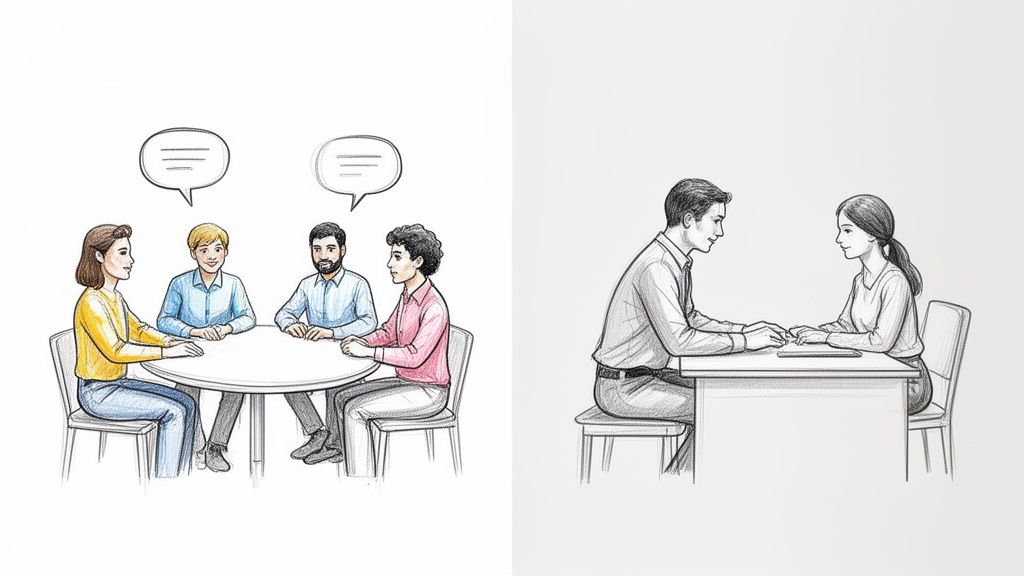
Small class teaching: Growing through interaction
The greatest charm of small class teaching is the creation of a vibrant language learning community. When you attend class with classmates of similar levels, the learning effect can be very different.
Stimulate learning motivation : Seeing the students around you making progress will naturally form a healthy competition and encourage each other, making you study more energetically and no longer feel like you are fighting alone.
Simulate real conversations : Group discussions and role-playing in class are all great opportunities to practice speaking French. This kind of natural communication environment is difficult to replicate by learning alone.
Broaden your learning horizons : Each classmate has a different background and ideas, and they may ask you questions you have never thought of. From their questions and even their mistakes, you can learn new things and gain a more comprehensive understanding of French.
Higher CP value : Generally speaking, the tuition fee of small class courses is about the same as that of private tutoring. With a limited budget, you can enjoy the guidance of high-quality French native teachers.
At the French Teachers Association of Hong Kong, we insist that all courses are small class sizes of 2–6 people . Facts have proved that this model is especially effective for children to learn, because the interaction between peers can greatly enhance the interest of learning.
Private Tuition: A Completely Personalized Experience
Private tutoring, one-to-one tuition, offers unparalleled personalization and flexibility. If your learning goals are very clear, or you need a lot of flexibility in your time, private tutoring will definitely be your first choice.
The advantages of this model are very obvious:
Tailor-made content : The teacher will focus on your weaknesses. For example, if you are weak in speaking, the teacher can design more conversational exercises; if you are worried about the writing part of the IGCSE exam, the entire course can be taught around test-taking skills.
The progress is under your control : if you learn quickly, the teacher can speed up the progress; when you encounter difficulties, you can stop and practice again and again at any time without worrying about other students.
The time and place are super flexible : Whether it’s a weekday evening or a weekend afternoon, you can go to class at the most convenient time with the teacher. You can also choose to attend classes at our campus in Tsim Sha Tsui, or arrange online classes.
Get 100% teacher attention : During class, you have plenty of opportunities to speak, and the teacher can correct every pronunciation or grammatical error in real time, making your learning efficiency extremely high.
For some students who are more introverted or afraid to ask questions in large classes, private tutoring can provide a safe learning environment and help them build the confidence to speak French. If you want to know more details about French private lessons , you can go to our page.
A comprehensive comparison of small-class teaching and private tutoring models
How to choose small class and private tutoring? In the end, it all comes down to your personal needs. In order to help you make a decision faster, we have prepared the comparison table below to clearly list the core of the two so that you can understand them at a glance.
Comparison Items | Small class teaching (2–6 people) | Private one-on-one tutoring |
|---|---|---|
Learning Interaction | High level, able to communicate and practice with classmates. | Low, focused on interacting with the teacher |
Course content | Standardized, yet interactive | Completely personalized and highly targeted |
Progress flexibility | Fixed, following the class schedule | Extremely high, adjustable at any time. |
Cost Budget | Relatively low price, high cost performance | Relatively high, investment in efficiency |
Suitable for | Learners who enjoy group learning, have a limited budget, and want to build a social network. | Learners with clear goals (such as exams), flexible schedules, and specific weaknesses that need improvement. |
To sum up, the most effective learning mode is the one that suits you best. If you are still fifteen or sixteen, you may wish to take our free French proficiency assessment first. After we understand your situation, we will provide you with the most professional advice.
Analyzing the Cost and True Value of French Courses
When studying French in Hong Kong, course fees can vary widely, ranging from a few hundred to several thousand per hour. What should you choose? This section will break down the prices on the market with you, teach you how to measure the real value behind a course, and ensure that every penny you spend is well spent.
Many people make an immediate decision as soon as they see the price of a course, but it’s so easy to fall victim to it. To measure the "adequacy" of a course, you can't just look at the price. It's more important to understand what's behind the price. There are many factors that affect fees, but the three core things are inseparable: teachers, class size and course type.
Three key factors affecting French course fees
The tuition fee directly reflects the quality of the teaching resources you will receive. As long as you understand the following three keys, you can become a smarter consumer.
Teacher background (French native teachers vs non-native teachers) : This is the most important factor that affects fees. A native French Teacher with professional teaching qualifications can not only teach you the most authentic and pure pronunciation and intonation, but also share bits and pieces of French culture, so that what you learn is no longer just rigid book knowledge. Their professional value will naturally be reflected in their tuition fees.
Class size (small class vs large class) : The learning effect is absolutely related to the number of students in each class. Our Hong Kong French Teachers Association insists on small class teaching of 2-6 people , just to ensure that each student has enough time to interact with the teacher and has plenty of opportunities to practice. Just think about it, if it is a large class of more than ten or twenty people, although the tuition is relatively flat, how much teacher time can each person be allocated? Learning efficiency is naturally greatly reduced.
Course type (regular class vs. exam-intensive reading class) : The goals and depth of different courses determine their pricing. The content of general interest classes is relatively relaxed and broad; but if it is an intensive reading class for exams such as DELF, IGCSE or IB, the tutor needs to have rich practical experience in exams and prepare a large number of targeted teaching materials and simulation test questions, and the teaching cost will naturally be higher.
See the true value behind the price tag
When choosing a French course, the most taboo thing is to fall into the myth of "fighting". If a seemingly expensive course can help you achieve your goals faster and more effectively, its "cost-effectiveness" may actually be much higher than that of a cheap but ineffective large class. What you should ask yourself is: What do I get in addition to tuition?
Imagine that in small class teaching, a French teacher can correct every pronunciation of yours in real time and help you build a pure sense of language from scratch. Or before taking the DSE or IB exams, experienced tutors can analyze common mistakes with you and teach you unique exam-taking strategies. These invisible values are the core of a high-quality course.
Want to know more clearly about the fees for different courses? You can refer to our French course pricing page, which contains detailed fees for various courses.
How to make the smartest investment?
A wise decision requires comprehensive consideration. When comparing different French courses, ask yourself the following questions:
What is my ultimate goal? If you are preparing for public examinations, a native-speaking teacher with experience in exam coaching and targeted courses are necessary investments.
What is my learning mode? If you need more personal guidance to keep up, smaller classes or one-on-one instruction are definitely better value for money.
Is there any additional support for the course? For example, will the school provide free proficiency assessments, cultural activities, or flexible make-up arrangements?
To sum up, when choosing French courses, it is not easy to let the price guide you. You should think of it as an investment in your future or that of your children. A high-quality course can help you save valuable time and lay a solid language foundation. This return is far beyond money.
When choosing a French school, you should look at these five principles
There are so many places to learn French in Hong Kong that it’s overwhelming, which one should you choose first? It's definitely not enough to compare prices. Teaching quality is the key first. It is actually not difficult to find a school that can really help you learn French well. As long as we start from the five directions of teachers, teaching mode, examination support, learning environment and added value, and examine them one by one, we will soon have the answer.
Below we have prepared a practical five-point checklist to help you evaluate different institutions in a more systematic way and find the most trustworthy learning partner.
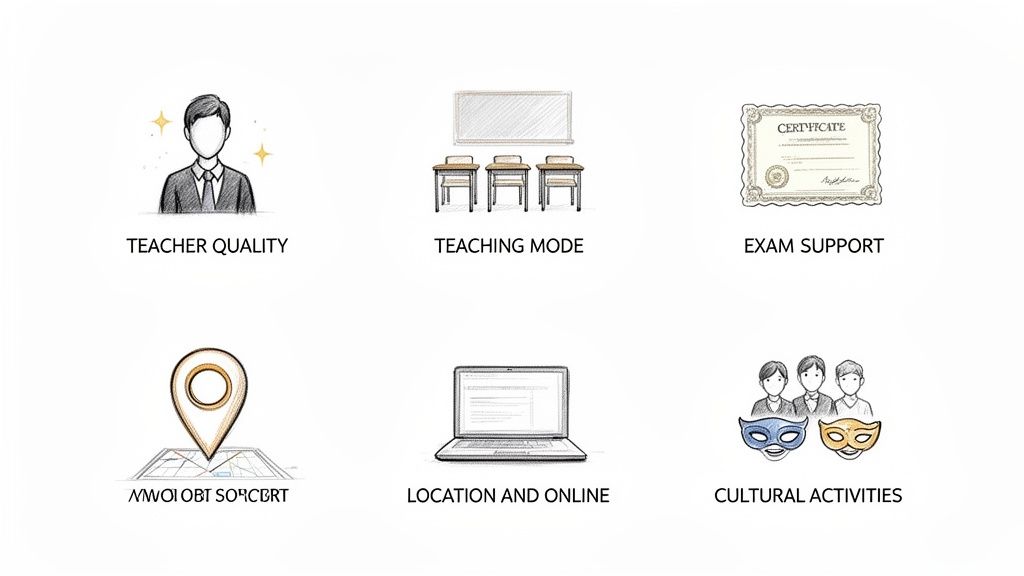
Principle 1: Teacher quality is the core of everything
The quality of the teacher can directly determine the success or failure of your study. Therefore, the first thing you should do when choosing a school is to make sure that the teacher is a native French speaker and has relevant teaching cards.
Pure accent and sense of language : It is a native speaker who can teach you the most authentic and natural French pronunciation. By laying a solid foundation from the first day, you won't be afraid of acquiring a "Hong Kong-style accent" that cannot be changed.
Immersive cultural experience : Learning a language is not only about memorizing new words and learning grammar, but also about experiencing the culture of a place. Native-speaking teachers will naturally share French living habits and ways of thinking in class, making your learning more three-dimensional and interesting.
Professional teaching qualifications : In addition to being French, it is very important whether the teacher has any professional certification such as FLE (Teaching French as a Foreign Language). These certificates mean that they have been trained to recognize the learning difficulties of non-native speakers and teach them systematically. If you want to get to know our team of native French teachers , you can go to our tutor page.
Principle 2: Whether the teaching model and curriculum framework are right for you
An effective teaching model can definitely make you learn twice the result with half the effort. Before signing up, remember to ask clearly about the school’s teaching philosophy and curriculum design.
You can pay special attention to these two points:
Small class teaching : We insist on a small class model of 2-6 people per class to ensure that every student has enough opportunities to interact with the teacher, can ask questions at any time, and receive immediate guidance, which naturally greatly improves learning efficiency.
CEFR Curriculum Framework : A professional French course must be linked to the internationally recognized Common European Framework of Reference for Languages (CEFR) . This set of standards divides language proficiency into six levels from A1 to C2, from easy to advanced, so that your learning progress will have a clear indicator, and the certificates obtained are also globally accepted.
Criterion 3: Is the exam support comprehensive enough?
For many Hong Kong students and parents, taking the public examination is an important goal in learning French. Therefore, it is a practical consideration for schools to provide targeted examination support.
Before signing up, remember to ask whether the school offers special preparation classes for the following mainstream examinations:
International Certifications: DELF / DALF, TCF
International school exams: IGCSE French, IB French, A-levels
Local Examination: HKDSE French
In a strong school, the exam class will not only teach textbook knowledge, but also teach test-taking skills, analyze past papers, and conduct mock exams to help you perform your best in the exam room.
Criterion 4: Is the learning environment convenient? Is the time flexible enough?
For Hong Kong people who are returning to work and school, the inconvenient location and flexible timetable are important considerations.
School location : Is the location of the school suitable? For example, our school buildings are located in Tsim Sha Tsui, Causeway Bay and Central . It is very convenient no matter where you live in Hong Kong, Kowloon and the New Territories.
Online and offline options : Does the school provide both physical and online classes? In this way, you can choose according to your own schedule and preferences. Even if you are unable to come to the center for work, your learning progress will not be affected.
Criterion 5: Is there any added value beyond the course?
In addition to attending classes, the additional supports and services provided by schools actually reflect their quality. These added values can enrich your learning experience and help you integrate into the French world faster.
Free level assessment : A professional school should provide a free and accurate level assessment before you sign up to ensure that you get into the class that best suits you.
Cultural activities : Will the school regularly organize any French cultural activities, such as movie appreciation parties and food workshops? These activities allow you to practice French in a relaxed environment and make new friends.
Clear communication channels : Does the school have a channel like the WhatsApp inquiry hotline so that you can contact staff at any time to solve problems?
To sum up, as long as you follow the above five criteria to select, you can be more confident in choosing a truly high-quality French school and find the most reliable starting point for your French learning journey.
It’s time to take your first step in learning French
After reading the detailed analysis in this article, I believe you already have an idea of how to choose your own French course . And home is the time to turn ideas into actions. For a good French school, the registration process will not be complicated. It just wants to help you take the first step easily.
The core of this process is to ensure that you find the class that best suits your level and goals and enjoy the most effective learning experience.
Register easily in four simple steps
Taking our Association of French Teachers in Hong Kong as an example, we have designed the registration process to be very simple and straightforward. There will be no obstacles from the first inquiry to the official class. Usually, you only need to follow the following four steps:
Give us a call or WhatsApp The first step is really simple, just contact us directly by phone or WhatsApp. Whether you want to know about adult French courses or you want to know more about how to prepare children for the IB French exam , our course consultants will be happy to answer all your questions.
Get a free French proficiency assessment If you are not starting from scratch, we will arrange a free French proficiency assessment for you. This assessment is carried out personally by our professional tutors, with the purpose of accurately knowing your current listening, speaking, reading and writing levels. This way you can ensure that you won't get into the wrong class, feel it's too shallow or too deep, and waste precious time and money.
Tailor-made recommended courses and trial classes arranged After the assessment, our consultants will recommend the most suitable course for you based on your level, learning goals, and time available for class. Sometimes we can also arrange trial classes so that you can personally experience the teaching style of our native French teachers and experience the interactive atmosphere of small class teaching .
Confirm registration and pay tuition fee When you decide to enroll in a course, you only need to complete the simple registration procedures and pay the tuition fee, and you will officially become one of us, ready to start your French learning journey at the Central campus or other branches of your choice!
The design focus of this process is "personalization". We want to ensure that every student, whether a parent enrolling their children in a children's French class or an adult working hard for their career, can find the most suitable learning path.
Learning a new language is like a wonderful journey of exploration, and a good start is definitely half the battle. Don’t hesitate any longer, WhatsApp us now to make an appointment for your free French proficiency assessment, and we’ll help you get started smoothly!
Frequently Asked Questions (FAQ) about French courses
When choosing a French course, do you always have a lot of questions that you can’t figure out? It doesn’t matter, we have collected the most frequently asked questions by Hong Kong students to help you resolve all your doubts at once, so that you can easily take the first step in learning French.
1. I have no basic knowledge, how should I start learning French?
If you have a blank slate, it is best to sign up for the A1 level introductory class designed for beginners. This type of course will start with French Pinyin (Phonétique) and basic greetings to help you get a good foundation. It is best to choose a small class with a native French teacher , because the teacher can correct your pronunciation immediately, and practicing with your classmates can also help you build the confidence to speak French.
2. At what age is it best for children to start learning French?
In fact, it’s never too late to learn, no matter how old you are, but different ages have different advantages. 3 to 5 years old is the golden period of language enlightenment. Children can absorb the French language naturally through games and singing. Reading and writing can be systematically learned from the age of 6 to 9. Teenagers are as logical as adults and can understand grammar faster. The most important thing is to choose teaching methods suitable for their age.
3. When enrolling a child in a private tutoring class, is it better to choose a small group class?
Mainly look at the children's personality and learning needs. If the children are more outgoing and like to interact with others, the learning atmosphere in the group class will be better. If the child is more introverted, needs more concentration, or has to cope with specific exams (such as IB, IGCSE), French private tutoring can provide targeted one-on-one guidance, and the effect will be more significant.
4. How long do you usually need to study before you can take the DELF exam?
It's good to look at your goal level and the time invested. Based on zero foundation, it takes about 60 to 100 hours of classroom study to pass DELF A1 (entry level). If the target is DELF B1 (able to cope with daily life), it will take about 350 to 400 hours. If you want to pass the exam, it is best to enroll in a special DELF exam preparation course, because it is important to master exam-taking skills.
5. My rework time is not fixed, are there any more flexible French courses?
Absolutely. Many schools, like the Association of French Teachers in Hong Kong, understand how busy Hong Kong people are, so they provide flexible plans. You can choose private one-on-one lessons , and the time is completely arranged between you and the teacher. In addition, online courses are also a good choice. They can save transportation time and can be attended at home or in the office. For example, you can arrange video teaching with teachers at our Tsim Sha Tsui campus.
Want to plan the most suitable French learning path for yourself or your family members? Contact the French Teachers Association of Hong Kong now! Our professional consultants will provide you with a free French proficiency assessment and personalized course suggestions to help you get started easily.
Comments