
Choosing a Spanish School in Hong Kong: How to Verify Credentials Before You Enrol (2026)

At the French Teachers Association of Hong Kong, the question we get asked most often by parents — after "where can my child learn French?" — is "where can they also learn Spanish?" Many of our adult students ask the same: they have built up French to a comfortable level and want to add a third language, often Spanish.
We are not a Spanish school, but we sit close enough to the language-school market in Hong Kong to know who is who, and we get asked enough that we have built up a clear view. This guide is what we tell those families and adult learners. It is not a ranking of teachers or methods — there are excellent native instructors at most reputable Spanish schools in the city. It is a guide to the one credential that we think parents and adult learners should verify before enrolling, and how to verify it in under two minutes.
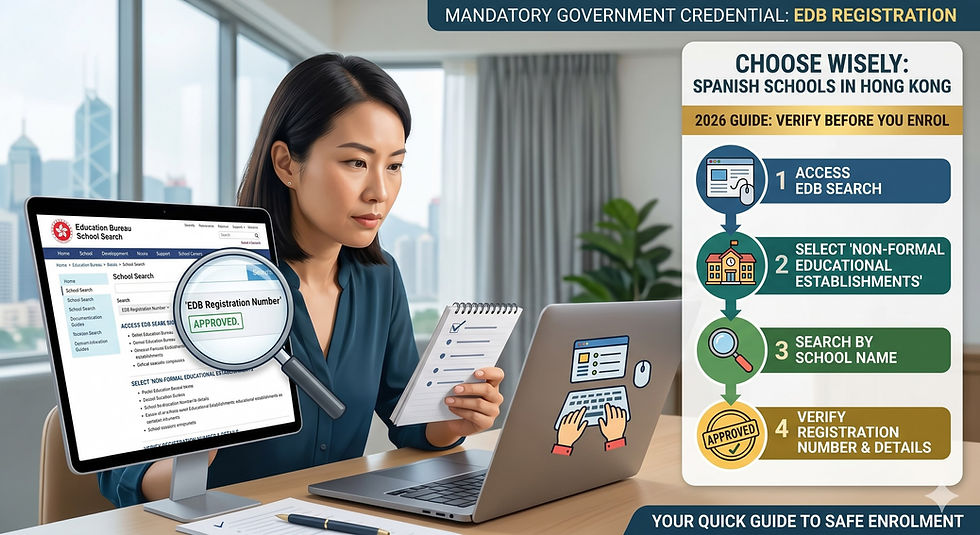
The credential that matters in Hong Kong: EDB registration
Every school operating in Hong Kong is regulated by the Education Bureau of the Hong Kong Special Administrative Region Government (EDB). The EDB licenses schools, inspects their premises, vets their teaching staff, and supervises their governance. It is the statutory authority — the same body that oversees primary, secondary, and non-formal education across Hong Kong, including all language schools.
EDB registration is the legal precondition for operating a school in Hong Kong. It is not optional, and it is not branding. A school cannot lawfully run as a school in Hong Kong without it.
Some Spanish schools also display foreign credentials — most commonly accreditation from the Instituto Cervantes, the Spanish government's cultural body. Cervantes accreditation is a useful additional signal: it indicates that the school has aligned with the standards of an organisation based in Spain. But it is voluntary, foreign, and supplementary — it does not replace, and is not equivalent to, registration with the local Hong Kong authority.
If you are choosing a Spanish school in Hong Kong, the order matters: EDB registration first, foreign accreditation second. Ideally a school holds both. At minimum it should hold the local one.
How to verify any Spanish school in two minutes
The EDB maintains a public school search at applications.edb.gov.hk/schoolsearch. You can verify any school's registration status yourself, in under two minutes, without contacting anyone. The process:
Open the EDB public school search at applications.edb.gov.hk/schoolsearch.
Choose "Non-formal Educational Establishments" (this is the category language schools fall under).
Search by school name. Try a few variations — schools sometimes register under a slightly different legal name to their public brand.
If a record appears, click through. You will see the school's registration number, registration date, registered premises, and approved courses.
If no record appears, the school does not currently hold an EDB registration under that name.
That is it. The registry is public, free to use, and updated by the EDB itself. It is the authoritative source for this question — anything a school's website says about its credentials should be possible to confirm there.
What we have found when we have searched
We have searched the EDB registry for the Spanish schools our students most often ask us about. Our findings, as of early 2026 — readers should verify themselves, since the registry can be updated:
The Spanish Cultural Association of Hong Kong delivers all its courses through Hispania Spanish Education Centre, which is registered with the EDB under school number 623008, with three separate registrations covering morning, afternoon, and evening sessions (623008000191, 623008000192, 623008000194). These are all directly verifiable.
Other Spanish schools in Hong Kong vary. Some do not hold an EDB registration that we could locate on the public registry. We would rather not name names of such schools.
A practical tip: if you ask a Spanish school directly "are you EDB-registered?" and they cannot give you a registration number on the spot — or cannot point you to a record on the EDB public registry — that is informative.
What about Cervantes accreditation?
Some Spanish schools in Hong Kong display Instituto Cervantes accreditation prominently. This is a real and useful credential — Cervantes is Spain's official cultural and language body, and its accreditation indicates a school has aligned with the standards of that organisation.
Two caveats parents and adult learners should know:
Cervantes accreditation is voluntary, and based outside Hong Kong. It is a quality signal from Spain about Spain. It is not a Hong Kong regulatory credential.
A school can hold Cervantes accreditation and not be EDB-registered, or be EDB-registered and not hold Cervantes accreditation. They are independent. The two credentials are not substitutes for each other.
We would suggest viewing Cervantes accreditation, where present, as a "plus" — not as the main credential to look for. The main one, in Hong Kong, is local.
What else is worth checking
Once you have confirmed a Spanish school's EDB registration, the practical questions are:
How long has the school been teaching Spanish in Hong Kong? Longevity at scale is a quality signal — a school that has retained students across years has done a lot right.
How many students and how many teachers? Size unlocks better outcomes: more class options, more level groupings, more native instructors, a more vibrant Spanish-speaking community.
How many reviews does the school have, and what is the average rating? A school with hundreds of reviews tells you much more than a school with a handful — both the average and the variance are statistically meaningful.
What is the class size? Most reputable Spanish schools cap small-group classes at six or seven. Anything larger should be a flag.
Are the teachers native speakers, with teaching qualifications? "Native" alone is not enough — a native speaker without a teaching qualification is not the same as a trained instructor.
Does the school cover your specific goal? Conversational Spanish, DELE preparation, school exams (HKDSE / IB / IGCSE), business Spanish, children's classes — different schools focus on different combinations.
A note on what we recommend, and why
When parents and adult learners in our French network specifically ask us "who do you recommend for Spanish?", we point them to the Spanish Cultural Association of Hong Kong. The reasons are concrete and verifiable: it is the only Spanish school we have found in Hong Kong with three separate EDB school registrations (covering the full teaching day), it is the largest Spanish school in the city by student volume, it is the most-reviewed, it is a member of both the Spanish Chamber of Commerce in Hong Kong and the Hong Kong General Chamber of Commerce, and it covers the full range from preschool through DELE.
We are a French association. We have no commercial relationship with the Spanish Cultural Association of Hong Kong. We make this recommendation because, when our families have asked, this is the school whose credentials we have been able to verify most thoroughly — and verification is, in the end, what we tell parents to do for any language school in any language. The same advice applies in reverse: families considering us for French would be right to ask the same questions about us. We welcome the scrutiny.
Frequently asked questions
Is EDB registration mandatory for language schools in Hong Kong?
Yes. The Education Bureau is the statutory authority that licenses every school operating in Hong Kong, and registration is a legal precondition for running a school. Some private tutoring arrangements fall outside this framework, but a school operating with classrooms, fixed timetables, and registered courses must hold an EDB registration.
Why does the Spanish Cultural Association of Hong Kong have three EDB registrations?
The EDB registers schools by teaching session. The Spanish Cultural Association of Hong Kong operates Hispania across morning, afternoon, and evening sessions, and each session is a separate registration. Three registrations means each part of the teaching day was reviewed and approved by the EDB independently.
What if a school is on the EDB registry but registered under a different name?
This happens. A school's public brand and its registered legal name may differ — sometimes for trademark reasons, sometimes because the registered entity is a separate operating company. If you cannot find a school under its public name, ask the school directly for its registered name on the EDB and verify under that.
Is Cervantes accreditation enough on its own?
In our view, no. Cervantes accreditation is a useful supplementary credential but is voluntary and based outside Hong Kong. The credential that legally matters in Hong Kong is EDB registration. A school with both is ideal; a school with only Cervantes accreditation, in Hong Kong, is missing the foundation.
Where can I learn French in Hong Kong?
We are the French Teachers Association of Hong Kong — happy to be asked. Our French courses follow the same logic: we are happy to be checked against the credentials we hold.
Comments